
Sign in
Request a demo
Talk with an accountant.
Connect with us:
Thank you! Your submission has been received!
Oops! Something went wrong while submitting the form.

Jason Berwanger, CEO:
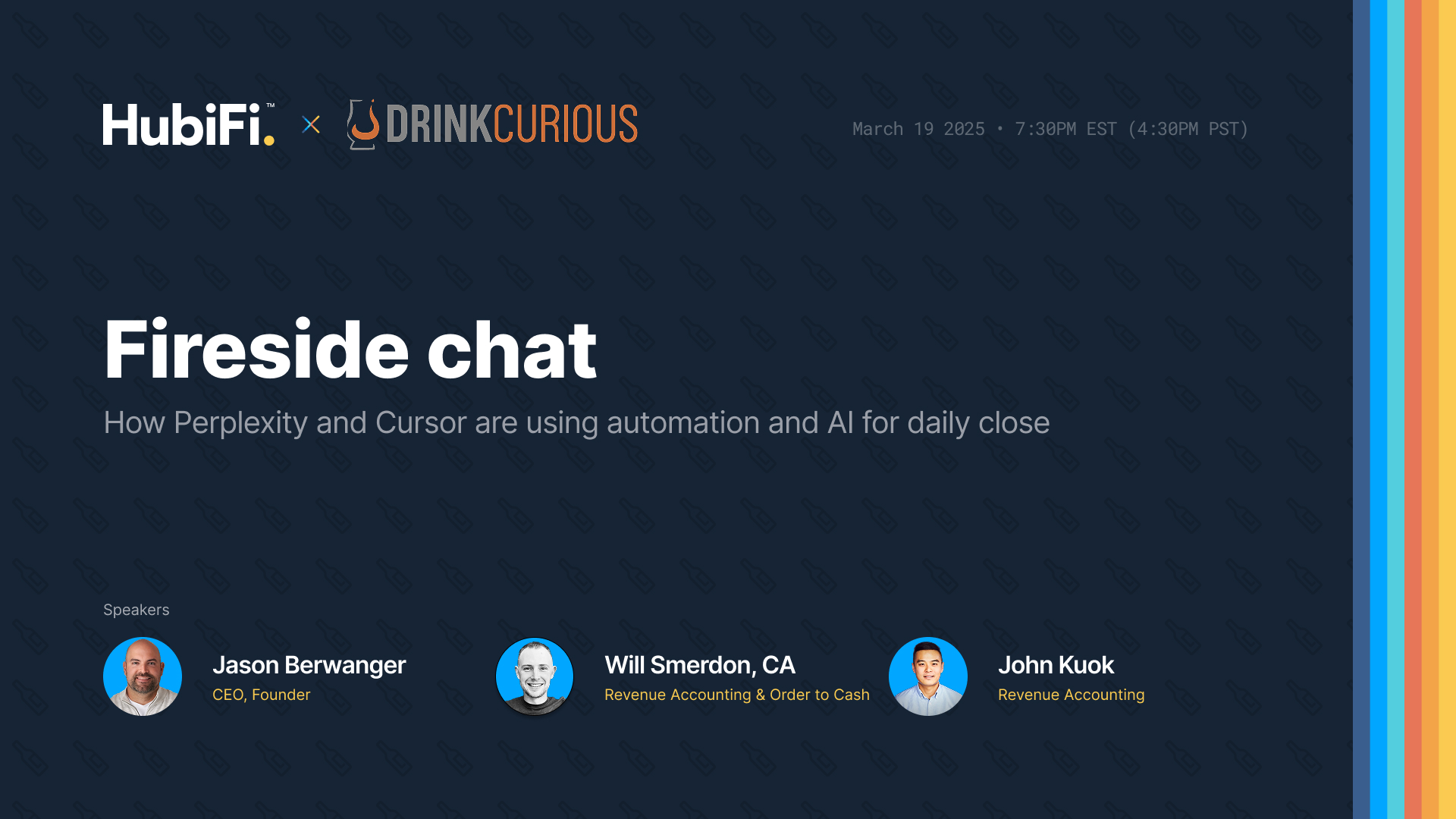
My mic was off, so you didn't get to hear my great speech there. Welcome. Uh, I think we're live. We're going to give folks probably about two minutes to kinda pull in, and then we'll get the event started. There is a chat, uh, although you cannot come off mute or come on screen until afterwards for the networking, but you absolutely can, and we'd love for you to use the chat to say, hey. Uh, say where you're from and maybe a favorite whiskey, and then we'll get started here in about ninety seconds. Chris, thanks for joining, man. I know rose and the wine event wasn't your things, but, hopefully, whiskey is your thing. Lindsay from NYC also happens to be the designer of this event. Thank you, Lindsay. Alright. So, uh, we'll give folks a couple minutes to get in. And, uh, yeah, thanks for joining. And, uh, you know, quick just housekeeping items. One, uh, mentioned earlier, uh, you will be on mute and you'll be off camera just as part of the event. We are doing networking afterwards, and then we'll be able to join some breakout rooms. Uh, otherwise, uh, there is a chat, uh, q and a for whiskey or speakers, completely welcomed. Otherwise, uh, we're gonna do some whiskey tasting, and then we're gonna talk to Will and Max about some of their experience with accounting automation, their careers, just in general, how to problem solving for some pretty cool organizations of Miro and Cursor. Uh, otherwise, Max and Will, if you guys don't mind, uh, why don't you give a quick introduction background, anything you'd like the audience to know?
Max Winsberg, Miro:
Yeah. So I'll get started. Hey. I'm Max. I work at Miro. I've been at Miro for about five years. I head our revenue accounting and operations team.
Um, really great to great to be here, talk with you all. Um, really, like, love working with Hubify and Jason and team here. So happy to answer any questions, um, that come up and help share some of the experiences that, uh, I've had in my career.
Will Smerdon, Cursor:
Thanks, Max. Um, I'm Will. I I joined Cursor about four months ago. Um, was at Fivetran and and previously Stripe before that, but I also lead our our revenue accounting and mortgage cash operations team.
Will Smerdon, Cursor::
bought to having some whiskeys, talking about AI and data. And also, you know, similarly echo what Max said, I'd I'd really enjoy working with with Jason and Cody. So appreciate you guys having me on.
Jason Berwanger, CEO:
Wonderful. Awesome. Well, without further ado, let's, uh, invite Steve who, uh, he'll give a quick intro, but he's gonna walk us through from the, uh, whiskey expertise side. Uh, we're gonna do some tastings, do some chatting, do some tasting chatting. So Steve will come and go and, uh, but quick introduction, Steve.
Steve Comes, Bourbon and Banter:
Excellent. Thanks, Jason. My name is Steve Coons. I'm a spirits educator. As somebody pointed out earlier, that is a lot of spirits behind, um, my me. I'm over my shoulders. This is my office. This is what I get to do. I get to teach it and drink it, and it's a lot of fun. And I'm so glad that we're gonna get a a good opportunity to share some of the bourbon gospel with you this mind. I'm gonna go ahead and start real quick. Here we go. So we call this bourbon in the blinds, not because you drink yourself blind or you drink blindfolded, but because you do not know what the brands are, what the labels are, what characteristics these these spirits have. You just go in and you drink it and you taste it and you nose it and you get to understand it a little bit better along the way. It's it's it's experiential. Right? So if you haven't opened your kit already, please open that and get your whiskeys out and pour it into the cups. You wanna let the spirit relax, burn off a little bit of or release, I should say, a little bit of the ethanol that's in there. And, uh, it'll perfume your room while we speak for a moment. Right? You have a bourbon flavor wheel there also, and that will help you identify some of the aromas and the flavors that you're tasting. And trust your memory. You're gonna smell and taste things and go, I know I've been in contact with that before. I've smelled it before. I've tasted it before. I've experienced it before. And maybe glance at that bourbon flavor wheel and kinda put two and two together and start to educate yourself the fun way just by, you know, just a little bit of self demonstration. So and, again, this is all before we get started, let's just give a couple of pro tasting tips. We all love wine, right, and we all are accustomed to sticking our noses way down the glass. Sometimes it's a little bit uncomfortable when you do spirits just because the the high proof and the amount of ethanol that's vaporizing it and going up near your nose. Try this when you're playing around, when you're listening through the demo with, uh, the Hubify presentation. You can smell these things and just keep yourself busy, keep yourself entertained, and draw it in through your mouth. That's a little more comfortable way to introduce that to your nose. Now I'm used to sticking my nose down in there, and sometimes it still stings a little bit, but that's the wisest way. Just a little retro nasal inhalation. Um, do all the stuff that you do with one. Hold it up to the light, swirly it around, have a look. You can kind of measure the body by what are either called tears or legs. I was in Mexico one time at a tequila presentation and a young man said if you see legs, you're single. If you see tears, you are married, which my wife of 30 years old was hilarious as much as I did too. Um, we wanna introduce you to it neat. If you're not used to drinking whiskey, neat. That's the fullest expression. You get all the flavor, the aroma, all the good stuff. And it it's just it's a better way to do it if you really wanna understand what you're drinking. If you have to add water, be aware that it might make it a little hotter, a little, you know, stronger, believe it or not. It does you have you create an exothermal reaction. Is that right? Exothermal? Where the molecules are banging into each other, the alcohol and the water not getting along, and it raises the temperature of glass by a couple of degrees, so, no, that could come. Or just go ahead and throw some ice if that makes you feel better. That's okay. No judging whatsoever. It's your whiskey. You drink it the way you like, but we hope you go with it neat. So why don't we stop there for a moment and hand it off to Jason because I know he's got important stuff to talk to, and we will get back to the bourbon in just a moment.
Jason Berwanger, CEO:
I I would not say what we have is more important than bourbon, so I'm just gonna go ahead and correct the record on that one. Cool. Well, uh, we're gonna do a little deep dive into, you know, kinda will the the cursor use case. So frame up, obviously, cursor, one of the fastest growing, uh, companies in the world, definitely one of the fastest growing AI companies in the world. Uh, you guys have, you know, some of the greatest technology known to man at your fingertips, and, uh, you're doing so with a handful of folks on the accounting and finance team. So clearly a lot of really efficient growth on top of that, which is pretty awesome. Tell the folks, uh, maybe about a little bit of the journey as you join Cursor, what they were doing prior, um, you know, how you think about, uh, systems supporting in order to cash, and just give maybe some landscape context for the audience.
Will Smerdon, Cursor:
Yeah. Um, Yeah. Thanks for framing that up. I I think that the interesting thing about, um, Cursa's business is that it has really taken off, uh, in the developer space, in the engineering space. And so it is heavily a product led, um, company at this point. Um, it's pretty amazing actually that we were able to to get to the level of revenue, um, that that we were able to achieve entirely on on Stripe, basically. So, like, our self-service business was the primary driver of of our revenue growth, um, through to basically, um, early twenty twenty five, um, when we're around seven seven hundred, eight hundred million in ARR. Um, and our sales led business has really kind of taken off, um, from around the start of of last year. Um, so, I mean, Stripe is obviously a fantastic product, um, and you can grow very quickly on Stripe as it handles. So, you know, it abstracts away the complexity of of payments and and invoicing and billing and all this kind of stuff. But with the amount of volume that we we had, um, it kind of starts to break how Stripe kind of functions in terms of the reporting and and the data and and all this kind of stuff. And, um, you know, basic reports out of Stripe these days, we just we can't even run them. They don't work. Um, if you try to run them, they they kinda just fail. And so, um, adding kind of a transformation layer or tooling in between, uh, Stripe and a a kind of ERP system is is really important. Um, and that's kind of where, um, Hubify came in. Um, and so getting getting to the the the scale that we've been at, all that we where we are now is was, um, much more straightforward than it would have been in, like, a much more complicated or maybe, um, heavily sales led business.
Jason Berwanger, CEO:
Yeah. Yeah. Definitely. You know, I think you nailed it. Stripe, uh, when it comes to at least the self serve order to cash scaling, there's nothing better than that in terms of your ROI for your engineering group being able to, you know, ship a product to be able to monetize it. Uh, but I think you you highlighted part of the key differentiator there is the the the volume drives a lot different of a problem. And so we often contrast sales led with the complexity as more of a a breadth and a depth where you can have n number of types of contracts, and there's very little consistency between them. Although as OTC lead, you're driving that consistency, and that's part of your job to say, hey. We can't really customize everything. Uh, but then on the PLG side, yeah, it really becomes a a volume game of, you know, there's thirty, thirty five ish, uh, transaction types that really happen in Stripe. And then and so that's capped in terms of the breadth, but then it becomes I hate to process billions of, you know, transactions that become tens of billions of journal entries. And, uh, yeah, that's that's precisely the type of, you know, novel problem that's not so novel for folks that are high volume on Stripe that you guys ran into.
Will Smerdon, Cursor:
Yeah. And and the type of of of people that you need to kind of, like, run as completely kind of, like, PLG, uh, uh, revenue function versus kind of like a more, uh, nuanced customized sales led function are totally different. And you could theoretically run, like, the the the self-service side with, you know, someone overseeing the policy component and then data reconciliation. Like, because that's ultimately what it's kind of become. Um, uh, and and and then on the the sales led side, there's a lot more kind of complexity that comes in in there, and it's it's more typical of what you'd see at, you know, revenue becoming function.
Jason Berwanger, CEO:
Yeah. Where there has to be an intentional decision by mostly a human being. Uh, a lot of times, that's judgment based on the terms of the contract that are are fairly bespoke. Yeah. Which which makes sense in in that problem statement.
Max Winsberg, Miro:
Yeah.
Will Smerdon, Cursor:
Yeah. Exactly. So I guess
Jason Berwanger, CEO:
when we we think about Hubify, we we're primarily automation, as you mentioned. Right? We're specific tooling built for, you know, high volume strike companies. And you have Cursor, you know, obviously, one of the best AI tech companies out there. How do you think about how some of that automation plays into how you're solving rev rec with automation? And then how does that help you or hinder you from an AI tech perspective and, um, interesting perspective for you, obviously, because you guys could build anything in a squish of why not build some of your own stuff.
Will Smerdon, Cursor:
Yeah. Um, and I think it's a pretty interesting topic right now. There's been, um, a lot of discussion about AI and using AI and and all this kind of stuff, but I think there's probably been less discussion on automation and data. And and, like, you need, um, to get the deterministic layer right first before you can kind of, like, leverage the the the the true benefits of AI. I was at a at a conference last last week, and they were talking exactly about this. And, like, the first step to to kind of leveraging AI well should be getting your data and your automations in place and getting that well understood before you actually try and layer any sort of, like, AI tooling on top of that.
Will Smerdon, Cursor:
Um, but, similarly, it it has kind of gotten to the point where, um, we are capable of building pretty much anything. Um, and so it's become a question of, like, not like, do I have time to build something, but, like, should I build something? And making sure What are
the trade offs? Yeah. Not building something for the sake of it, but building something that actually makes sense. I feel like we've almost become mini product managers in a way. Totally. Yeah. Yeah.
Jason Berwanger, CEO:
And that and that's exactly what a product manager has to do is evaluate what's the problem, what's the value of solving the problem. Now let me juxtapose the trade offs of the different solution approaches, and I think you said it well, uh, deterministic automation first. Yeah. That builds trust for a compliance and reporting layer. And then AI on top becomes the fun part that everyone wants to get to, but there I think there is a hard prerequisite there for finance and accounting use cases, not for all use cases. There's plenty of things like prototyping will never be the same as a product manager because the cost of prototyping something I mean, you prove this because you've you've put your builder on it, put things together overnight. Uh, when we've talked, I was I was pretty impressed at the speed of those things. And, yeah, it's it's really interesting to see what it has expanded versus where the rate offs no longer make sense. And, uh, Ben Murray, who we, uh, you know, we a lot of us follow on LinkedIn, he really is like the SaaS finance guy that speaks, and he actually came out and and shared something similar around, you know, uh, starting with AI ends up being the mistake because you really need to start further on to start with automation and centralizing the data, building the trust first. Yeah. And so it's really, you know, you know, a call to action from him for, you know, as a CFO, finance leader, OTC leader, not to jump to that even though it's it's really, um, it's really hard not to nowadays because the technology is so exciting and addicting to work with. It's like, why not why not skip to that part?
Will Smerdon, Cursor:
Yeah. I when I first got here, um, and I started to kinda play around with our product, um, I think that was probably part of there was there was, like, a glitz and glamour of of of using cursor to build things, and I was probably building more things than I should have been building or even that that made sense to to build. And then when we we I took a step back and really started to hone in on kind of, like, what are the what are the real areas that have the highest ROI for me spending time on doing this, and and where do I have the most, uh, detailed understanding of a process or an area or something like that. Um, that's kinda where we we started to see, like, the real value from that.
Jason Berwanger, CEO:
Yeah. Makes sense. And that that's truly product management decisions like you were mentioning. Yeah. So we we know automation is critical. And on its own, it's not gonna be the full solution, but it's at least the prerequisite to applying, you know, of AI being applied to it so that way you can get to this, like, full end to end solution. But maybe walk through what what are some good examples for you and the team of how you view some of this automation and the reporting layer that, you know, you can trust to then, uh, you know, some benefits for AI and your team.
Will Smerdon, Cursor:
Yeah. Um, I think I I was gonna talk about something else, and then I ended up working on something last night that I shared with Cody this morning. And, uh, and I think that's actually a better example of of of of how this kind of fits together. So, um, you have all your Stripe data. Right? You have then Hubify, you know, applying logic and, uh, uh, how to sell our GL mappings and everything like that. And we're using that to kind of, um, get to, uh, uh, journal entries in the end of a period. Um, but there's inherently a reconciliation process that has to occur between what's happening in Stripe, what's happening in Hubify, and how that ultimately lands in your GL. And so we have, you know, our Databricks instance that has all of our Stripe data. We now have all of our Hubify data kind of being egressed in on a on a regular basis, and now we have all our NetSuite data feeding feeding Databricks as well. So we have all of the raw information available to us. Um, it's like, how do we how would you take that step of then going ahead and reconciling everything to make sure that at the end of the period, um, everything that you expect to have been recorded has been recorded and everything kind of looks looks correct. And so, typically, I think the way that you would do that is by, you know, running or going to Stripe, looking at some report, taking a screenshot of that report or downloading that report, putting it in a spreadsheet, and then maybe going to Hubify and looking at one of your reviews or downloading the data and putting that into a spreadsheet and then doing some sort of, like, manual reconciliation or working with a, uh, a data engineer or an analyst or is on a data science team to basically, like, build a sequel for you to to to perform that validation, identify variances, and reconciling items and things like that. And so what I did last night was that I took, um, all of the the work that we'd done when we basically onboarded Hubify and the example reconciliations that we built. And I basically told Cursor, I want you to look at all of our Stripe data, and I want you to look at all of our Hubify data that's now, um, in Databricks. And I want you to tie that back to our journal entries in NetSuite. Uh, here are some examples of how we built this previously when we were onboarding Hubify. And so I want you to basically build me a dashboard that I can just look at live whenever the the information is is egressed in and show me the reconciliations and allow me to kind of, like, dive into it. And so I probably spent about maybe an hour last night doing this and was able to basically build an entire recon dashboard that is live and and updates, uh, every week when our data lands, um, that I don't have to actually I
don't have to go look at Stripe. I don't have to actually I don't even have to even take any of the reporting out of Hubify, but I have all the, obviously, the the automation there. Um, and that now just runs consistently, and and it's living there. It's something I can interact with. It actually breaks down variances. It buckets things together. It helps me identify what I actually need to follow-up on rather than actually, like, spending all the time to build.
Jason Berwanger, CEO:
It's your trust building exercise. Yeah. It's proven to you constantly that you can trust the data, which means that you're much more likely for me and the team to make decisions based off of it and know that you're compliant.
Will Smerdon, Cursor:
Yeah. Exactly. Yeah. And so what what we might do now is just spend, you know, two minutes going in and taking this taking a quick look at our our Stripe dashboard, and then that's it. Like, we're not gonna be spending time actually manually reconciling any of this activity. And we were able to kind of do this leveraging, uh, Cursor as a product, um, that level of like, it's gone off and it's reconciled millions and millions of transactions on its own with the parameters that I've given it, and then I've back tested it and things like that as we've gone through to get to a point of of understanding it.
Jason Berwanger, CEO:
Yeah. It's incredible. Yeah. We've we've calculated billions of transactions, and then you found a way to create composite reconciliations to prove you can trust it across all of the different systems, which is was pretty epic at that size and scale. Yeah. Unironically too, that concept of capturing the Stripe total and the ERP total and then comparing it, that's actually on our future roadmap for next quarter, and I'm super stoked about it. So I'm I'm not surprised that your mind went there either because you're like, I'm not I'm not reconciling any of this. Thank you.
Will Smerdon, Cursor:
No. And that and that's the thing. I think and I think a lot of accountants, especially revenue accountants, they feel like I'm spending too much time doing this type of stuff. And it's Yeah.
Jason Berwanger, CEO:
The job is the reconciliation in some sense. You you never get out of it.
Will Smerdon, Cursor:
Yeah. Exactly. And that's just not it's not necessarily value add, and it's not really what people wanna be doing either. Yeah.
Jason Berwanger, CEO:
Well said. Yeah. Take a quick question, and then we're gonna kick it back to Steve for the second whiskey. Uh, what do you consider high volume from Anthony? Uh, this is open to interpretation. High volume to me is synonymous with, hey. A manual process is gonna be pretty particularly painful in comparison to not high volume. I think accountants with Excel plus now AI and tooling can really do quite a bit, uh, on their own. But, uh, high volume really, you know, is open to the interpretation of the user in the sense that, uh, when there's enough volume that it creates an additional problem on the problem outside of just solving it and calculating it. But now managing inception to date reporting, what did I report last month versus this month, and you're accumulating enough of that volume where, hey. Now that's, like, inhibiting you, and now you become what Will mentioned, which is you're almost like a slave to the reconciliation process. So I I've talked to customers that have 900 customers in in Stripe, and they they consider that high volume and it's a pain enough. They made an investment. I've also talked to folks that are, you know, in the millions that are really weighing their options of, you know, is that high enough volume for us to care about this? Uh, you know, is it really breaking Excel yet? So, uh, Anthony, I would say, uh, uh, up to you. Although I think in the tens of thousands is probably the most common answer, but, uh, it is open to interpretation.
Will Smerdon, Cursor:
Yeah. Yeah. I would I would agree with that. I mean, we have over, you know, over a million customers, uh, on our self serve, um, model. And so, uh, that that that that number starts to get to that point that, you know, that Jason was alluding to where it's it's just like it's too time intensive to do the reconciliation manually. It's just not worth the time anymore.
Jason Berwanger, CEO:
Exactly. Oh. Awesome. Steve.
Steve Comes, Bourbon and Banter:
Everyone's thirsty. Hi, Jason. Alright. Let's get into it. Let's do I mean, a really quick sixty second education on here we go. It's the rules of bourbon. We're just gonna say why it's bourbon. It's a product of The United States. Has to be. Right? 1964, bourbon sales were low, and it didn't look like it was gonna come back at all. This is a market correction we're in right now, but back then, it was bad news. And they went to American legislators and said, we need some protection around our native spirit. We need to be able to say to the rest of the world, you can make whiskey, but you can't call it bourbon. So these are the rules we're gonna lay down, and these are it. There's 51% of the grain mixtures. A recipe that goes into the whiskey has to come from corn. Corn grows everywhere like crazy here in this part of the country, so they want a lot of corn. Secondly, it when it was distilled, it had to be stored in a new charred oak container, aka a barrel, the Amazon shipping container of the world for the last millennia. Right? As it's distilled, it cannot be distilled any higher than a 160 proof. Why? Because the higher you go on the proof, the more flavor you strip out. They want it to be a quality product. Bourbon now is distilled between a 130, a 140 proof, so much lower, much more flavorful. When it goes into that barrel, it can't go any higher than 125 proof, so it obviously has to be proofed down with water. When it goes into the bottle, it can't be any lower than 80 proof. It can be as high as it wants. I mean, I've seen bottled bourbon as high as a 160 proof, fright me, and called on the street hazmat. But still a lot of flavor, I have to say that. Um, legally, there is no age requirement for bourbon. If you could literally put take it off the stool, proof it down to 125, slosh it around in a new new charred oak container, and call it bourbon. It would be good bourbon, but it's legally bourbon. The only time the ages come in into mandate is when it's below four years old, two or three years old. It is decent whiskey. It's not great. And for some reason, they want them to kind of position that as a warning that it's not gonna be the best experience. But it's out there, and you can see it if you read the label sometimes. But once you get past four years, nobody has to disclose that age, but it is kind of a bargaining tool or or a marketing tool to be able to say, hey. This is ten years old. That says we've had it a long time, and we've taken good care of it. So let's get to the booze. Sample one. Pick it up, swish it around, do that retronasal, inhaling to draw that aroma into your nose. And anybody, if if if mics are live, they can say what they're smelling, but I'll I'll I'll see what I'm smelling. You can roll your eyes at what I say. Mine is only one pallet. Um, and everybody's just different. That's really that's really cool when you get around a bunch of different drinkers, smelling and tasting the very same things, and they're tasting and smelling all different stuff. There there is a large dried cherry note on this. There is a, uh, a high grain note. We'll talk about the grain that's that's putting out that aroma. And there is a little bit of a I don't know. You ever you ever seen chocolate that it's just a little bit moldy. That's a combination of chocolate and oak aromas that are showing up on, uh, this whiskey. Um, pretty light bodied. Not a lot going on. Not a lot clinging to the glass. My guess is that it's low proof. It's not my guess. I know what they are. Sorry. I shouldn't have said that. But the truth is it doesn't have a ton of body because it is a little bit lower proof. It's still really fruity, which I do like. Um, that's the distiller's exercise of, you know, putting the a particular yeast in it will give it fruit character when it's in the barrel, but also in how it's just citrus in there too, maybe some orange around it. Let me go ahead and taste. Here's the way I like to do it, by the way. Small taste first just to kinda condition the mouth. Just work it around. Don't do the mouthwash. That'll burn. And then go back with the second taste. And then gradually move that around the mouth. A lot going on. This is a well made whiskey. Toasted oak, toasted toasted bread, as a matter of fact, is what I get. Um, a little bit of that lemon carries over. There's some white pepper in there, maybe a little bit of baking spice. Baking spice being clove, nutmeg, cinnamon, all these things that you find in desserts. Um, does anybody wanna guess what it is before I do the big reveal? Come on, man. There's only 1,100, you know, bourbons on the market, so your odds are good. Alright. Let's go. Wyoming whiskey. It is made in Wyoming just as it says. 88 proof because that's kinda leading on 1888 when Wyoming was, uh, allowed into The United States as a state. Little marketing hook. But it tastes good at that proof, I think. So, uh, these are distillers notes below here, and and mine will probably not align directly, but these are what they say. Floral notes, you know, notes of vanilla bean, caramel pudding. I could agree with that. Floral with baking spices, brown butter. That's pretty cool note. Creme care well, let's see. Vanilla creme, caramel, and a hint of cinnamon. So we're we'll kinda pair a little tracks there. Finish. Finish is what is how they describe the flavors that remain in the mouth after you have swallowed it and also what you feel as it goes down the throat. So it's it's it's a lightly warm finish. It's not scorching. It's not the Kentucky hug that we talk about here in Kentucky where it can burn. And but vanilla and spice fade away as it goes away. Now the interesting thing about this, it is a wheated bourbon, meaning wheat is the flavor grain. Again, most of the grain in bourbon has to be corn to be called bourbon, and it typically uses malted barley, which helps with, uh, enzymatic reactions during cooking and fermentation and mashing and all that good stuff. In the middle are the flavor grains where people traditionally choose rye and bourbon, but these guys chose wheat, which presents a little bit softer, a little bit, um, more toward the baking spice side. But, boy, when you get past a 100 proof, wheat really catches its, you know, its mojo. Um, you get a lot more fruit, a lot more cinnamon, a lot more all kinds of goodness. So at lower proofs, this still presents pretty well. So hopefully everybody liked this one. Five years old too. It's not an old whiskey. It's got a long way to go in terms of maturity if they wanna age it further. Let's compare that to sample two based on what the left toe The nose is very different. Still a bourbon. A lot more oak influence to me. I mean, when I by that, I mean, there's a little bit of a campfire. There is, uh, maybe an older home, grandma's attic, some might say. Just older, drier wood. Right? I wanna say deeper darker chocolate, but that's not really it. Sometimes I get a little bit of black licorice in the background. It's just a darker note overall. Leather is what it is. Some people if you're horse riders, just call it horse tack because because that's kinda what it smells like. Can you believe all that comes from grain and distillation? And a mild fruit note, little bit of cough syrup, kinda cherry cough syrup. That's really romancing and isn't it? Just but that's that's what you smell, and that's what you say, and you say whatever you wanna say when you're talking about your particular realm your what what what you're picking up in particular. Always always personalize it. Don't listen to what the other person says. Let's go ahead and do this sip again. It's a short one. Much sweeter, but still darker and deeper than the other one. A little bit of spice character in there that wasn't in the first one in the, uh, Wyoming. Take another sip. Now for me, I'm not a smoker but, uh, especially in Kentucky, you go grow up around tobacco barns and things like that, so we know what drying tobacco smells like, like a cigar leaf. I really get that aroma and that flavor on the palate. Um, a little bit of chocolate cake in there. Not not quite birthday cake, but just deeper darker espresso. If you ever use that cake, maybe that's there for hopefully, everybody likes this. I'm gonna do the reveal. This is Russell's Reserve that's made by Wild Turkey Distillery. It's 90 proof, so it's just a touch higher than the other. Um, ten years in the in the barrel, though. That's that's quite a thing. You know? To to keep it that long, it's a very difficult thing. It can be a little bit too long if it gets too hot in the barrel over time. It can be too little if it doesn't get hot enough. So to walk a whiskey that long, you know, and and and see that it's treated well, believe it or not, is much more than chance. There's a real strategy that goes into that. Um, it also richens the whiskey in this case. It's, you know, the distiller is saying, uh, citrus notes with butterscotch, maple, oak. Yeah. I would agree with all that. Vanilla, by the way, something today that I'm not picking up on, not you don't get the same thing every day when you're tasting the air that you're breathing, the food that you've had, what you've drunk. You know, I've just drunk water all day beside this, but sometimes it really does influence what you do or don't taste. I agree the taste is rich. It's spicy. Caramel flavors for sure. Smooth and sweet. Toffee and spice notes lingering with a mild and pleasant warming finish. I love it. This bottle of whiskey is, in Kentucky, $35 for a ten year old bourbon, which is fantastic. Uh, the last one, the the Wyoming, is probably closer to $45. Half the age. Age isn't you know, age sometimes means a lot, sometimes it doesn't. I love this whiskey and hope you do as well. I'm gonna pass it back to Jason and get back to the serious stuff.
Jason Berwanger, CEO:
Alright. Max, you, uh, you guys have, uh, a lot of transactions on Stripe. You got NetSuite, and, uh, it it really feels like from what you shared with me before and our time with you, you guys have been through the ringer. You've tried a lot of solutions and primarily pushing a lot of transactions into your ERP and really trying to keep Stripe and NetSuite in sync. What went right? What went wrong?
Max Winsberg, Miro:
Yeah. So we have several years of experience. And just for a little bit of background, we are pushing, translating every single Stripe transaction, invoices, payments, credit memos over to NetSuite. We have hundreds of thousands of transactions a month, so million per year. As you can imagine, it's a full time job or maybe two to make sure that data stays in sync and is reconciled. The issue with that is we use NetSuite suite sync, which I believe is the standard out of the box, um, translation. And you find problems. You find use case scenarios that, hey. This isn't really acting the way I want it to. This isn't the correct accounting output we want it to. So you dig into that. You say, okay. How can I go about fix this? A lot of our fixes tended to be NetSuite scripts. So the Stripe transactions sync over to NetSuite. We'll have we'll work with our technology team, try to come up with some logic in a script to fix that one specific issue. The problem is you fix one issue, another one pops up. You solve that one, another one pops up. So just really felt like a full time job just managing the translation between Stripe and NetSuite for us. And it felt like you're just managing, uh, a dumb translation. It's not helping you in any way. You're just spending a whole bunch of time just trying to maintain the status quo, not really providing any value or yeah. Not really providing any value to the business. Just trying to make sure you maintain the status quo and are able to close with accurate numbers.
Jason Berwanger, CEO:
Yeah. And we I feel like it's a pattern too. We we think about and we talk about this as a team, and I know you and I have talked about this is the it's like this unbundling concept of you really have a general ledger and a finance hub, and then you have where your customers transact. And the minute that's unbundled, the the cost of trying to get it back into the ERP to then get a benefit, like, it I don't care how good you are. Like, it's it's a it's a diminishing return that ends up, like you mentioned, becoming a reconciliation for the reconciliation sake of getting into NetSuite without really a lot of benefit, um, and arguably a lot more cost than benefit based on the payroll hours and the, you know, the amount of NetSuite direct cost for managing the data, etcetera. So, um, but you you hit on the I think another key point too, which is, like, there's, uh, there's a lot of edge cases in other scenarios that don't go in there. And I know you and I spent a lot of time, uh, and and with Cody as well around, like, customer balance transactions and just, like, certain things that SuiteSync and NetSuite really just didn't have a home for that we're, you know, working with you guys to try to codify.
Max Winsberg, Miro:
Yeah. Absolutely. So not sure if this everyone's sweet sync is set up. Uh, we got lucky enough where I don't know if everyone's familiar here with customer balance transactions, but it's basically a black hole or a a bucket where Stripe will put everything into a customer balance for, say, a downgrade. A customer has unused time credits. They'll put it onto the Stripe customer balance. And that really doesn't work well in this whole NetSuite connection, this NetSuite sync suite sync. So what we found in our problem specifically was we allowed customers to downgrade. So you could buy 10 seats midway through the contract. You could then downgrade to five. And so what our issue was was when the customer downgraded, that information was not coming over from Stripe to NetSuite. So we have this whole issue then of not recording we're overstating revenue at that point unless there's some sort of manual intervention that takes place. So this was not a small issue. This took my team weeks and weeks to actually have to reconcile. The point is I don't want my team having to spend their entire jobs doing this just to get the numbers right. So, um, that that was the issue, like, the main issue. And I think to some of the other topics before this is, like, you're you're trying to understand why you have this issue and, like, hey. Is this, like, the best way to operate as a business? So kind of unpack the impact to revenue, impact of hours spent, and you go back and take this information to Seth to your CFO, to your leadership, and say, hey. Like, maybe it's not worth letting customers downgrade in this instance. So that's what we did. So we're able to solve that specific issue through Hubify if we wanted to, but then we also realized, hey. As a business, like, this doesn't make sense for us. Um, and we're able to drive change, like, through through that as well.
Jason Berwanger, CEO:
Yeah. I think that's my my favorite part of your guys' project was there was there's clearly a ton of, uh, a benefit for your team and the investment you made both the effort as well as the Hubify partnership. But the the level of connectivity to how your operation worked and the the fact that you can go make recommendations and point out to your operational team what's actually how the customer's transacting and then question that with, you know, data back that ties right back to your P and L or balance sheet. That's just really cool. Right? Like, that feels like the strategic accountant's dream. And so we were we were stoked for you and the outcomes that you're able to get for you and your team, not just for the automation and the benefit, but also, you know, more of the, you know, strategic seat of the table argument where you can start to make those recommendations because you had all the data to see all the patterns. And, again, to Will's point, you know, you guys aren't spending the time on reconciliations because now you're figuring out, alright, how do we really wanna do this as a business? Because it's costing us. And the answer was no. And that's a question that would have never been supposed had you and the team never gotten out of the reconciliation trying to manage suite sync world.
Max Winsberg, Miro:
Yeah. Absolutely. And that's one example I know that we that we went through. Um, the the cool thing about whenever you implement a new system, you really, um, take inventory of all your existing processes and then, you know, talk to Jason, talk to talk to Cody in the implementation. They really ask them why are you doing it this way. And you say, I don't know or this is how things have always been. And I think that's when you start to to go and really investigate, like, why am I doing certain things and, hey, maybe we could change this for the better, not just for the sake of our team, but for the sake of the business. So this one specific issue was not the only the only item. We had an outdated or not a great way to provide credits for start up, um, companies. Essentially, we would throw a credit on a customer balance. The issue with doing it that way, it's really hard to track the applications, upset credit. So now we're going back to the business and saying, hey. Why are we doing it this way? Let's provide a coupon instead. Hubify will be able to track that for us. We'll be able to put time limits on the coupons that people get. So it it's not just, you know, like, automating things, but it's really making the business run run better.
Jason Berwanger, CEO:
Yes. Spot on. Yeah. And and you have to do both. You have to first figure out the compliance and reconciliation, and then you can move on to the fun stuff. And so it is very much a, you know, hard prerequisite because, like, can't ignore my accounting responsibilities, but if we automate it now, we can use that as a superpower, which is is pretty cool.
Steve Comes, Bourbon and Banter:
Um, Yeah.
Max Winsberg, Miro:
I I would say I would say just to point out, like, when you're not reconciling things, you have the time to put together a presentation or to explain, hey. Why do we need to make this change, um, and try to really change the way your business is operating when you're just heads down trying to make sure numbers close or or numbers are accurate. You really don't have time to do anything else.
Jason Berwanger, CEO:
Huge. Yep. And the other data point I'll I'll share is we, uh, we added it up, and there's, uh, 34 different endpoints of Stripe transaction types that can happen, not just with balance transactions, but with other records. And SweetSync, NetSuite, you know, Stripe, or Everac, None of these tools actually have kept up with all the operational effect that can happen from a payment or a billing or subscription perspective. And I think that's what catches a lot of folks is it doesn't map clearly to the ERP. And, like, you have to you have to think about the accounting use cases as you're developing the product, and that's really the role that we've we've played with Stripe is to keep up on the accounting side with all the operational changes. And then we end up then, at that point, being able to yield the, hey. We're doing a lot of this x y z downgrade. Why are we doing that? Well, that's because we're tracking everything in and out Stripe at that point and lets lets you guys, you know, operate as you want to.
Max Winsberg, Miro:
Yeah. And as a as a team of I think we have two two other people besides myself who are really in in the weeds on the Stripe. It's it's really good to have partners, um, like yourself and Cody. We could say why is Stripe operating this way. You guys have all all the answers seemingly for us. So it's really good. Just have someone else to bounce ideas. Hey. Are we are we doing this the right way? How are other companies doing it well? So it's just really good to have a a thought partner in in Hubify as well.
Jason Berwanger, CEO:
Yeah. And it's insane that you guys can have that much thought volume, and you figured out now to how to automate the whole thing. And then you also have time to make strategic recommendations with a tiny team and hundreds of thousands of transactions, which is, uh, yeah. Yeah. That that's impressive and something you guys should be proud of.
Max Winsberg, Miro:
Yeah. I'll I'll really thanks to you guys. And, uh, but I get I guess to the the point that I think overall theme here from hearing, like, Will speak and then just going over our our use cases, you can't really build upon bad process ease and and bad data. So you really wanna get that groundwork, um, and that foundation strong first.
Steve Comes, Bourbon and Banter:
That's right.
Jason Berwanger, CEO:
Steve, more thirst.
Steve Comes, Bourbon and Banter:
Alright, Jason. Let's go. Do a little share here. Okay. Everybody's thirsty now? You had a little break? Take up whiskey number three. Treat it as you have the others. Hold it up. Have a look at the body a little bit more. A little medium body. Definitely a different aroma. Very herbal. Um, little dill, a little bit of mint in there. Some wintergreen candy, maybe. Gonna give you some hints. If you're an experienced whiskey drinker, you don't know where we're going with this. Look. It's very candied. Some peppermint in there as well. Just go ahead and do the two sip. It's like a dance. Right? Like, the two step with the two sip. This is my jam. It's kind of stuff I like. I like spicy herbal whiskeys. Um, not a lot of sweetness there, but there is some. This is a Kentucky style rye. We're just gonna give you that hint. Right? To be a rye, it's like bourbon. You know? Bourbon has to have 51% corn at the very least. Uh, rye has to have 51% rye grain in the mash bill at the very least. The dominant grain is the one that the whiskey is named after. This one has quite a bit of corn after that. So it's got a nice big mouthfeel. It's kind of honeyed. That doesn't come from rye. That comes from corn. A little bit of that comes also from the malted barley that's in it's in the green mash bill there. I like this a lot. I think it coats the mouth really well. I think that, um, something like this would just pair so so well with steak because it will take care of the fat. It will cleanse the palate really nicely. Some people say they don't like rye. Hopefully, you do like it. And this is what it is, mixture's US one rye. So low proof, 84.8, but I think it presents much higher. It presents much richer as well. They don't disclose their mash bills, but, again, it says, you know, that 51% rye, so that just makes it rye for sure. Aged only five to seven years old. However, some of the aging techniques that that Michter's uses and some of their barrel entry proofs, a lot of technical talk that we don't have time to go into, affects that whiskey in a very, very positive way. It makes it very rich, very luxurious. So it says on the nose, oak vanilla spice, a bit of dark fruit, um, rye spice on the palate, citrus vanilla, oak, and butterscotch. Absolutely. That that corn comes through and delivers that butterscotch note. And some peppery spice on the finish. Absolutely. That is a quality both of rye grain and um, aging and, uh, fermentation as well. Sometimes you can ferment it to make it, you know, have a much more spicy character. I'll I'll give the thirty second tutorial on fermentation. Fermentation is once the grain is cooked and broken down to where those complex carbohydrates come apart and you have sugar that can be easily fermented in the process, that's fermentation. And fermentation is when sugar is turned into alcohol and c o two, and that's what's happening to give the spice character in this, uh, rye whiskey as much as the rye itself. So it's kind of cool. Hopefully, you like that one. Let's move on to the next. But keep in mind now that we've got this rye in there how different it is gonna be from the next bourbon. Alright. Sample four. Very different nose. There's a whole lot of wood going on there, a whole lot of oak, and dark oak, meaning heavily charred barrel. It's kind of ashen. Got a little campfire note, which I found really pleasant. Some people will nose this and and come off with I I think they're conflating memories and they'll say, um, s'mores, like, they're getting some marshmallow. Now confectioner's sugar shows up a lot in good whiskey, um, and that's a barrel characteristic, but I'm not getting that. I just get the the the burned wood, the charred oak. Now some of that butterscotch character that we found in the rye showing up in the bourbon. It's a very full bodied whiskey. Hold that one up to the the light. You definitely see the legs, and I promise you I'm not single. Don't wanna be single. I enjoy being married. You're 31, baby. We're in it for the long haul. Even it doesn't even make noises in the glass when you swish it if you've noticed that. That's how heavy bodied that thing is. Now I'm getting a little bit of toasted bread again as I did on on the earlier I think number one. But, also, this is what if you've not been to a Rick house where they age, uh, whiskey, it's just a big giant wooden warehouse, that's what it smells like. It smells exactly like that. Let's go ahead and do the two sip. Big fruit character. Banana, especially a kind of dried banana. Can you tell I've been playing around with banana chips? I do a lot of food and whiskey pairings. It's one of the things I've entered into pairing sometimes. Fruitcake, if you ever had a good one, not a bad one, but a good one, that's that that flavor is in there for me too. Kind of a moist chocolate, not a pudding, but maybe a half melted candy bar. And all those things sound crazy, but that's what I taste and that's what I smell. Um, little bit of leather, not a lot. I think the the number two whiskey, the, uh, Russell's Reserve definitely had a lot more leather. And as we're gonna know in just a second, let me just talk about it before we reveal it. It's a double oaked, so that means it was in the charred oak barrel that it stayed in for five to seven years, and then it was added to a second chart oak barrel to amplify those oak notes for about another five months. So if that gives you any hints as to what it is, this is it. Woodford double oaked. A lot of people like Woodford Reserve. I remember when it was created in 1996, it is now a 2,000,000 case brand, which is a pretty big brand. Jack Daniels by comparison is 16 and a half million cases, just in case you wanted to know. It's a little proof at for me anyway at at 90.4, but it has a lot of flavors. So proof doesn't necessarily matter in that carrot in in in this situation. Look at the mash bill. 72 percent corn, 18% rye, 10% malted barley. That's a lot of corn, and it comes off nicely. Sharp honey, chocolate, marzipan. If anyone knows what marzipan is, that's almond paste and toasted oak. Palette, full bodied mix of vanilla, dark caramel, hazelnut, apple fruit, and spices. Is it a dessert whiskey? Kind of. It's not sweet like some dessert whiskeys, but it certainly would complement, uh, a heavy cheesecake or an apple pie or something like that. Finish long and creamy with lingering hints of honeyed apple. I'll buy that. Fuzzy as it sound, I'll buy that, especially the honeyed part. So that concludes my part of the presentation. I hope you enjoyed it. I hope it was informative, and, hopefully, you have a little bit of whiskey left to get you through, and enjoy the rest of the presentation. Back to you, Jason.
Jason Berwanger, CEO:
Steve, wonderful job. Yes, sir. Learned a lot, and thank you so much for hosting with us tonight and, uh, joining.
Steve Comes, Bourbon and Banter:
Well, it's my pleasure. I get to do this for a living. Remember? This is fun.
Jason Berwanger, CEO:
So Kentucky hug. I'll never forget it.
Steve Comes, Bourbon and Banter:
Alright, everybody. Thank you so much.
Jason Berwanger, CEO:
Thank you, Steve. Alright, gents. Uh, final round. Uh, you guys both have, uh, scaled some pretty, uh, not so small organizations hyper efficiently. Uh, what advice do you have for folks about how to how to build an efficient, you know, accounting org and how to solve rev rec? What, uh, what do you have to share with the audience?
Max Winsberg, Miro:
I'll go first then, Will. Yeah. I would I would say, at least, don't don't be afraid to to dive into I mean, I think we all know where certain things could go wrong. I think in the back of the head, that one thing that keeps you up at night, um, don't run from it for forever. It will eventually catch up. Like, if you like, all businesses should try to scale. Right? Like, you want more revenue. You want more transactions. So what are those kind of the the faulty foundation that if you just build and build and build won't be able to scale with your organization? Um, people are always gonna want you to close faster, get information quicker. So really just trying to take a look at your entire process as a whole. Um, and I've I had to double that tomorrow, what processes are gonna break down, what's gonna fail, and then try to attack those, um, with the mindset maybe just a little bit further out than your your day to day.
Jason Berwanger, CEO:
Yeah. So, really, the automation matters almost for two reasons. One, it's, uh, you know, sounds like risk mitigation, uh, and really the sleep at night protection of knowing that something's gonna be done consistent without human process. That that feels pretty key. That also sounds like that information more often. That that feels like the other bit for you that's important, Max, which is almost the the daily or more often trustworthy closed revenue data. So that way you guys can be enabled to go be business partners. Uh, that feels like the two themes I think I'm hearing, but tell me if I missed it.
Max Winsberg, Miro:
No. You're absolutely right. Um, we wanna be more than the the typical accountant. Right? Um, we wanna work on I wanna work on on better problems than closing the books. So I think also just as as a leader of the organization, I see my team being frustrated with doing the same thing over and over and over again. Like, I wanna provide my team growth as well, and they're not gonna do that by doing the same process, same manual process over and over again. So beyond, I guess, everything that it does help the business. Right? You do provide better information faster too, but really to provide personal growth to the team where they could actually focus on more strategic initiatives and and have growth opportunities, I think, is another another big reason that haven't really commented on yet today.
Jason Berwanger, CEO:
Yeah. Great for your people and keeping talent. Uh, great for the overall finance team. And then, yeah, sleep at night account and productions feels like good enough good enough reasoning for me.
Will Smerdon, Cursor:
Yep. Yeah. And I I I have a couple of kind of bullet points that I wrote down, like, thinking about this, but it's it's really like automation and data cleanliness is kind of like the baseline for all of this so that your ai can be useful like without that the ai is not that helpful So so spend the time Getting that right first and it will pay dividends on on the back end Don't try to build what's already been solved right there are there are tools out there that exist for a reason and like it makes sense. So like layering into the next point of of like build tools where you're the expert like a lot of people in these in these areas are you know subject matter experts in specific area areas and like it's way faster to Take what's in your brain and your understanding of the process and your knowledge of the data and and using tooling like cursor or or something else to
Max Winsberg, Miro:
kind of like build a
Will Smerdon, Cursor:
process that fits your needs right now. Um, and that doesn't necessarily mean that um, what you build today is going to be, you know, like the the things that we're building are not enterprise products. That's not the point. The point is kind of like progress over perfection. So, like, let's relieve some of this pain today through, you know, automation and a I and and have that help kinda guide, like, where we go tomorrow.
Jason Berwanger, CEO:
I like it. And, ironically, I think both to Max's point, the the foundational investment in automation getting out of manual process for people, and then your point, the foundational automation ends up being enabled for AI. So it it really is it's the universal first step if you're gonna take your team and your technology to the next step. It means you gotta make that foundational investment, and it's not sexy, but I think you both said the same thing from a different different lens.
Will Smerdon, Cursor:
Yeah. Definitely.
Jason Berwanger, CEO:
Awesome. Cool. Well, uh, Max, well, you guys are awesome. Thank you for spending time out of your days, nights, uh, day for you, Will. Night for you, Max. And, uh, appreciate the insights for the audience in joining Tell Stories. Uh, I, for one, greatly appreciate it, and I know a lot of folks did. We have some good questions. Uh, if you have any other questions, q and a wise, throw them in the chat. Uh, we're gonna wrap up the event. There is a, uh, breakout networking that the SQL thingy has that Christine behind the scenes will kick off. Uh, as we close down the event here in the next minute or two after we finish any q and a, you can hit, uh, join, and you'll then be placed into basically breakout rooms where you can come off camera and chat, uh, and, you know, three of us will be there plus a bunch of other folks from the audience. If anybody chooses to join, we can go network, and, usually, we have, uh, some good chitchat afterwards. So if that's interesting, feel free to stick around. Just hit join so you're not left out. Uh, otherwise, we'll check to make sure there's, uh, no other questions. Chris, uh, thanks, man. Appreciate the support. Uh, otherwise, yeah, it looks like there's nothing in the q and a. So, Christine, cue the awkward countdown.
.png)


.jpg)

.jpg)
.jpg)
.jpg)
.jpg)
.jpg)
.jpg)
.jpg)

