
Sign in
Request a demo
Talk with an accountant.
Connect with us:
Thank you! Your submission has been received!
Oops! Something went wrong while submitting the form.

Every first finance leader faces a similar set of challenges at the beginning: figuring out the right technology, team, and priorities to invest. Brittany Belote, Controller at Rillet, and Sheila Ellis, Controller at Talkiatry, have each built accounting functions from scratch multiple times, at companies of wildly different sizes.
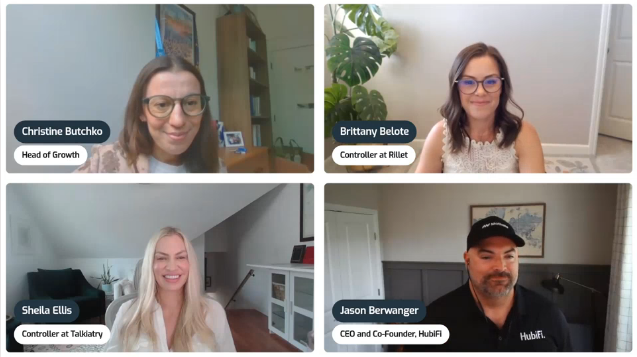
Every first finance leader faces a similar set of challenges at the beginning: figuring out the right technology, team, and priorities to invest. Brittany Belote, Controller at Rillet, and Sheila Ellis, Controller at Talkiatry, have each built accounting functions from scratch multiple times, at companies of wildly different sizes. Jason Berwanger, HubiFi’s CEO, has observed the same pattern from the systems side, across six ERP implementations and a career split between working as an accountant and building tools for them.
The three recently sat down for a session on what it actually takes to stand up an accounting function from zero. Here are some their biggest insights:
Ask any of the three what to prioritize in the earliest days, and the answer is cash.
Brittany said to start with signature and spend policy, a simple rule for who can commit the company to a contract or an expense. Without it, forecasting turns into guesswork, and accruals stop being complete. T&E guardrails come next, mostly because people want to follow the rules; they just need someone to write them down.
Then there's the treasury. Both Brittany and Sheila both cited the Silicon Valley Bank collapse as the moment cash controls stopped being optional. Dual approvals, direct debit blockers, bank diversification aren't sophisticated ideas, but they're the ones that prevent a single point of failure from becoming a company-ending event.
Jason added a layer above that: revenue. Investors won't expect audit-ready books from a seed-stage company, but they will expect real earned-revenue metrics and a deferred revenue waterfall. The gap he sees most often is the distance between ARR as tracked in a CRM and revenue as recognized under GAAP. Those two numbers can diverge sharply, and it's finance's job to own that difference before an investor, or a quality-of-earnings review, finds it first.
According to Brittany, the first cracks rarely appear in the financials themselves, but rather leadership’s questions, a close that’s getting longer, or reporting that has increased complexity.
Sheila pointed to a simpler tell: if the team can't get to anything besides closing the books, that's the signal. When close eats the whole month, there's no room left for the work that actually moves a business forward.
Jason framed the breakdown in terms of business model. Companies selling through a traditional enterprise motion tend to see billing and invoicing processes buckle first, because finance sits too far from sales.
Usage-based or product-led companies see something different: accounting struggles to stay attached to how the business actually monetizes, and teams end up reconciling third-party systems instead of running the business.
The panel was unanimous that the software-versus-headcount debate is usually the wrong one to have. Jason advice: define how the business model is actually going to scale before deciding on either. Set milestones. Decide in advance what growth trigger should force a rebuild of a manual process, rather than reacting once it's already broken.
Define how the business model is actually going to scale before deciding on either. Set milestones. Decide in advance what growth trigger should force a rebuild of a manual process, rather than reacting once it's already broken.
Brittany put it more bluntly, headcount is the last resort, not a first move. Her focus stays on evaluating systems and automating workflows; adding people only enters the conversation once a problem is well-defined enough that a new hire can actually own it and grow into it. Hiring too early, she noted, tends to be a bad experience for everyone involved, including the person hired.
When the conversation turned to what makes a strong first accounting hire, nobody mentioned years of experience or technical certifications.
Brittany looks for people who self-manage, execute without being pushed, and stay open to new technology. Sheila wants curiosity above all and someone who will go find the answer rather than wait for it, whether that means digging through documentation or, increasingly, asking an AI tool to explain a process from scratch.
That shift matters because the work itself is changing. Reconciliations and manual data entry are being automated to the point where the job is less about performing the task and more about exercising judgment on what the automation surfaces.
Jason’s framing of AI's role in accounting was the most concrete moment of the session. He split accounting problems into two categories: deterministic ones, which need to produce the same answer every time and hold up under audit, and probabilistic ones, where an estimate is genuinely acceptable.
For example: a CECL reserve based on historical collection patterns.
Most accounting work, he argued, is deterministic by nature, and that's exactly where automation belongs first. Once a company has a trustworthy, automated source of truth, AI becomes useful as a layer on top, spotting the variance nobody flagged, explaining why a dispute rate ticked up, or surfacing the cohort driving a trend.
Sheila agreed, describing the shift as one from preparer to reviewer: the manual grunt work disappears, but someone still has to check the output and make the call.
Strip away the specific tools and titles, and the session kept circling back to one idea: accounting infrastructure decisions are business decisions, not back-office chores.
The controllers who get ahead of the problem by bringing on cash controls and revenue policy early, and evaluate systems before headcount, aren't just protecting an audit two years out.
To catch a recap of the webinar, watch it here.

Accounting Automation | Product | Technical Accounting | Accounting Systems Nerd
Cody Leach, CPA is a technology and automation focused CPA helping finance leaders bring their processes into the 21st century. He's advised finance teams around technical accounting and automation - such as Cursor, Meta, Strava, and many others and has helped SaaS and AI finance teams turn messy and usage data into clean, automated revenue reporting that actually matches how the business runs. Former KPMG auditor, Cody holds in Masters in Accounting from North Carolina State University. He is a CPA.
Enter your email to get our latest insights straight to your inbox.
*Or watch 2 minute demo here.
Power your high-volume business's revenue compliance and reporting needs with one platform.