
Sign in
Request a demo
Talk with an accountant.
Connect with us:
Thank you! Your submission has been received!
Oops! Something went wrong while submitting the form.

Uber had rolled out Anthropic's Claude Code to roughly 5,000 engineers, and adoption surged from 32% of the engineering org in February to 84% by March. Nearly 95% of engineers were using AI tools monthly, meaning that token consumption was off the charts.
.png)
In April 2026, Uber's CTO confirmed that the company had burned through its entire annual AI budget in four months.
Uber had rolled out Anthropic's Claude Code to roughly 5,000 engineers, and adoption surged from 32% of the engineering org in February to 84% by March. Nearly 95% of engineers were using AI tools monthly, meaning that token consumption was off the charts.
The problem was what came after all that usage. Per-engineer monthly API costs ballooned to between $500 and $2,000 for power users, far past internal forecasts.When Uber's COO Andrew Macdonald was asked whether rising AI token consumption was translating into meaningfully better products, his answer was blunt: "That link is not there yet."
Uber has since implemented usage caps, but the damage was already done.
For finance teams evaluating AI agents and automation tools, this story is a warning shot - not against AI but against deploying AI without understanding how the cost model works.
To understand why Uber's budget evaporated, you need to understand how AI agents actually consume resources.
A basic chatbot or single-turn LLM call is relatively cheap and most teams price usage of the LLM chatbot on a subscription basis.
Agents, however, don’t work that way. Instead they reason about a task, call a tool or external system, evaluate the output, reason again, call another tool, check the result, and so on until the task is complete, or until they fail silently and you don't find out until later.
For a high-volume finance operation (reconciliations, journal entry generation, revenue recognition) that multiplier compounds fast.
The deeper problem is that the cost per task isn't fixed, but variable. An agent tackling a simple transaction might complete in two loops. The same agent hitting an edge case might loop 15 times before producing an output (which may still be wrong), making budgeting for agentic AI workflows genuinely difficult without careful up-front modeling.
Uber's problem was primarily a cost overrun; for finance teams, the stakes go a level higher. In engineering, an AI agent that produces imperfect code still has a human reviewing the commit and the error has a chance to get caught before it ships.
Finance doesn't have that margin, however. Issues in accounting surface up during audits, and restating revenue is costly and time-consuming. Therefore, the cost model isn't just about token spend, it includes the cost of errors, human review required to catch those errors, and remediation when errors slip through.
If your team is evaluating agentic finance tools, or if you've already deployed one and haven't stress-tested the cost model, here are the questions worth working through before you sign or expand.
1. How many inference loops does this agent actually run per task?
Ask vendors directly to show you token logs for representative transactions. A vendor who can't answer this question doesn't have a real cost model.
Alternatively, run the math yourself. If the agent loops an average of 8 times per transaction, your transaction volume is 50,000/month, and the current cost per 1M tokens is X, you can model the monthly inference cost. Then double it, because edge cases are more common in finance than demos suggest.
2. Is the core accounting logic actually deterministic?
This is the most important architectural question and the one most likely to get glossed over in a sales cycle.
A well-built finance automation platform has core logic that considers revenue recognition, reconciliation, ERP posting, which should always produce the same output for the same input. The AI layer, if there is one, should sit above that: drafting narratives, surfacing anomalies, answering questions about data, not deciding how to classify a transaction.
When the AI agent is the rules engine, you get Uber's problem but worse: not just unpredictable cost, but unpredictable accounting.
3. What does human review actually cost at your volume?
Agentic AI outputs require human oversight, which is easy to say and expensive to run.
Before deploying an AI agent on any finance workflow, map out what review actually looks like at your transaction volume. Who reviews? How long does it take per transaction? What's the escalation path for edge cases? Add that fully-loaded cost to the inference cost, and you have a real picture of what this agent costs.
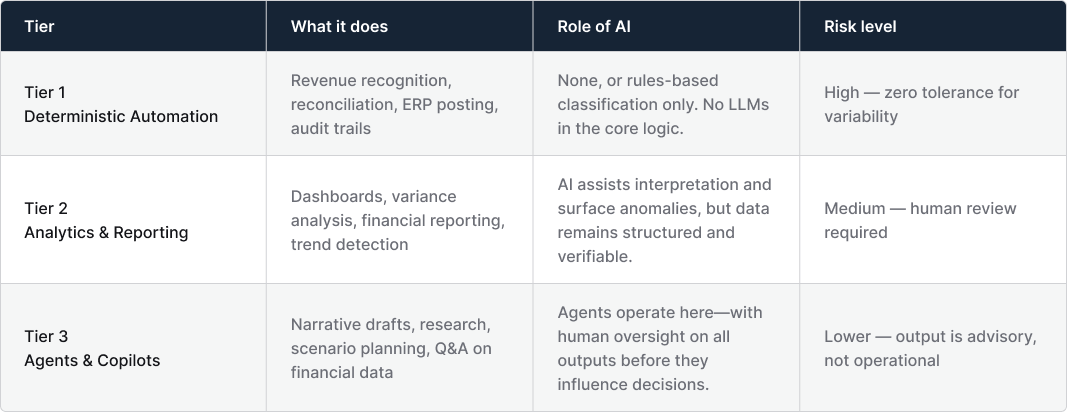
None of this is an argument against automation in finance. It's an argument for being precise about which tool does which job.
Here's the framework we use at HubiFi:
Tier 1 Deterministic automation: Revenue recognition, reconciliation, ERP posting, audit trails. No LLMs in the core logic. Same input, always the same output. Fully auditable.
Tier 2 Analytics and reporting: Dashboards, variance analysis, trend detection. AI can assist interpretation here, but the underlying data is structured and verifiable.
Tier 3 Agents and copilots: Variance commentary, narrative drafts, scenario planning, research. This is where agents belong, producing advisory output that a human reviews before it influences any decision.
Uber's story is going to repeat itself across a lot of companies over the next 12-18 months. The warning signs are already there: impressive adoption metrics, aggressive AI-native vendor pitches, and budgets that weren't built to handle the inference cost of agents looping at scale.
Finance teams that get ahead of this now will be in a better position than those who discover the problem after a close goes sideways.
Before your next vendor evaluation, build a real cost model: inference costs at your volume, human review time, error remediation costs, and the cost of an audit finding if something slips through. Stack that against the workflow automation alternative, which doesn't loop, doesn't vary, and produces the same answer every time.
The goal isn't to avoid AI, but to make sure the AI you deploy is the right tool for the specific job, and that you can defend the decision to your board, your auditors, and your own team when it matters.
HubiFi is a revenue accounting automation platform built on deterministic automation for every process that touches your books. Learn more at hubifi.com.

Accounting Automation | Product | Technical Accounting | Accounting Systems Nerd
Cody Leach, CPA is a technology and automation focused CPA helping finance leaders bring their processes into the 21st century. He's advised finance teams around technical accounting and automation - such as Cursor, Meta, Strava, and many others and has helped SaaS and AI finance teams turn messy and usage data into clean, automated revenue reporting that actually matches how the business runs. Former KPMG auditor, Cody holds in Masters in Accounting from North Carolina State University. He is a CPA.
Enter your email to get our latest insights straight to your inbox.
- OR -