
Sign in
Request a demo
Talk with an accountant.
Connect with us:
Thank you! Your submission has been received!
Oops! Something went wrong while submitting the form.

Your ERP promised one system of record. Now it's a costly general ledger with 45+ disconnected tools. Learn why unbundling happened and what finance leaders do.
.png)
The average mid-size enterprise accounting team today is dealing with roughly 45 to 47 disconnected systems. It’s a far cry from the world where your ERP housed all of your operational and financial data.
How did we get here? Two words: customer innovation. New payment processors, CRM systems, and billing tools made it easier for customers to transact with businesses. Previously all of your operational and financial data sat in your ERP, now accounting has to navigate ingesting and transforming data from disparate systems in order to close the books and build reporting.
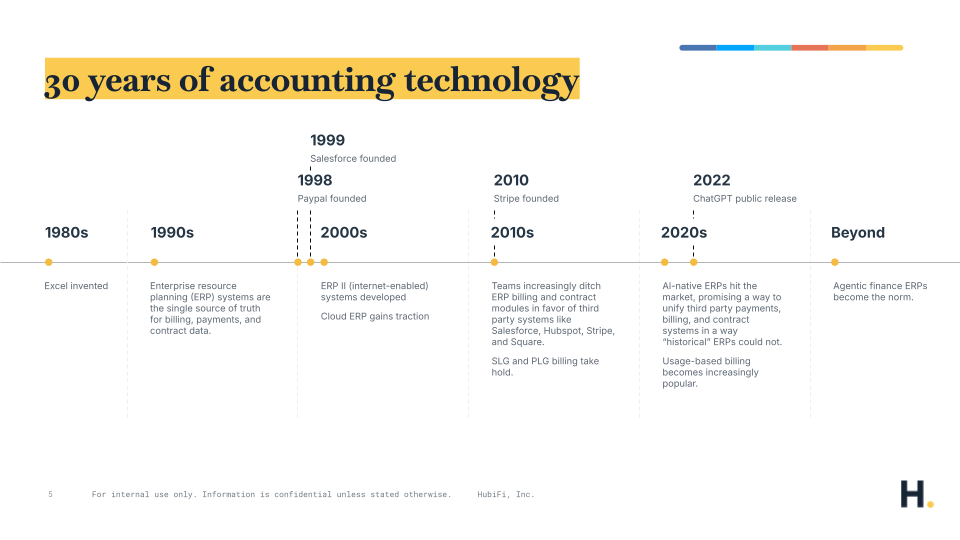
When the ERP first came to market, it was originally built to serve two purposes: operational standardization (customers, contracts, orders, invoices, payments) and finance and accounting (what's actually happening in the business). For manufacturers and companies with high-dollar, high-complexity transactions, this coupling worked beautifully. The accounting view of the world was directly connected to the operational layer and teams could trace, audit, and tie their revenue numbers back directly to the inputs of their systems.
The dot com boom and SaaS changed everything. PayPal decentralized payments. Salesforce took over customer relationship management. Suddenly, two foundational data sources, payment processing and customer records no longer lived in the ERP.
From there, businesses began adopting tools like Stripe, Recurly, app store billing, custom data warehouse pipelines to make it easier than ever to meet customer demands. Each of those tools in isolation create some manual efforts, but add in three or four disparate tools, and accounting got a lot more manual.
"What happens is that unbundling leaves the accounting and finance groups in a less automated and more error-prone world," Jason Berwanger noted during our recent webinar on this topic. "Even though this is 20 years ago compared to an ERP, it’s less automated than it was 20 years ago."
The result of prioritizing customer innovation is that the average mid-size enterprise accounting team today is dealing with roughly 45 to 47 disconnected systems. Each one of those systems has its own data model that doesn’t align 1:1 with your ERP’s GL. That means that teams must pull data from the payments, billing, or CRM tool, manually map it to their chart of accounts logic, and eventually post it to the GL.
As Caitlin Steel put it: "I didn't go to school and take the CPA exam so that I could cut and paste stuff into Excel. That wasn't my career trajectory."
When your team is spending most of their time on reconciliation and trying to prove that the number in Stripe matches the number in NetSuite, then they're not doing what CPAs are actually trained to do: understand the business, identify risk, and support decision-making.
"Your finance and accounting is now tackling the reconciliation portion of the problem and less about being strategic," Jason said. "Less about using the data like they would've 20 years ago if all our data was in the ERP and linked to the operation."
Modern ERPs haven't failed, rather they've just been asked to do a job they were never designed to do in today's environment, which is to ingest data from independent sources and still act like the operational layer for those transactions.
The practical consequence of operational data being unbundled from financial data shows up in audit findings. According to the PCAOB, nearly a quarter of public audits have deficiencies and a disproportionate number are concentrated in revenue, inventory, and cost of revenue, exactly the areas where customer transaction data lives outside the ERP.
A shortage of accounting professionals, combined with a proliferation of disconnected systems and audit standards that haven't relaxed have only further exacerbated these challenges. Still, the ERP does well and provides the compliance reporting framework like chart of accounts, journal entries, audit trails at the GL level, period-end close.
There's a lot of enthusiasm right now about AI-native ERPs and agentic finance (which we share), but there's also a sequencing problem worth being direct about.
While AI is extraordinary at answering questions, it's not built for deterministic accounting.
That means that a transaction needs to be posted correctly, every time, with full audit lineage, with the same answer regardless of who asks the question. The issue is that LLMs are probabilistic by nature, so applying them to the foundational layer of your accounting process is the wrong tool for the job.
.png)
As Caitlin described it: "If I was a controller sitting in a company right now, I'd be very worried about my reputation with an AI out there on top of my manually generated books."
The right mental model is a pyramid. At the base: raw transactional data from all your operational systems. In the middle: deterministic automation that translates those transactions into accounting-ready data - clean, reconciled, GAAP-compliant, with full lineage back to source. At the top of the ERP layer: standardized reporting and compliance frameworks. And only then, at the very tip: AI and agents to answer business questions, surface anomalies, and provide the kind of analytical horsepower that actually delivers on the "AI in finance" promise.
"You really need those operational details at the baseline to have a deterministic automation layer," Caitlin said, "so that when your AI does go answer questions, it's basing that on data you can trust."
Build from the top down and you get a system that "probably got it right, but I just can't prove it” which isn’t a viable state for a finance team that's responsible for public or investor-grade financials.
The frame we use at HubiFi is this: the problem isn't the ERP. The problem is that the customer transactional layer and the accounting layer have been severed from each other, and the bridge between them has been duct-taped together with spreadsheets, manual processes, and heroic accounting team effort.
The solution isn't a better ERP. It's a deterministic layer that connects where your customers are actually transacting, Stripe, Recurly, Apple, Google, your data warehouse billing system, to your accounting and ERP infrastructure. One that runs the reconciliation automatically, closes the books daily, maintains full audit traceability at the transaction level, and hands your accounting team clean, usable data instead of a pile of exports to reconcile.
Once that foundation exists, the AI use cases that get everyone excited actually become viable through variance analysis that surfaces the two transactions out of 50,000 that don't look right or materiality assessments.
"Both AI and getting the office of the CFO on the same page means revenue has to have a single source," Jason noted. Without that, FP&A has one revenue number and accounting has another, and the teams spend close weeks debating whose number is right instead of analyzing it.
The great ERP unbundling wasn't a mistake. It was the market responding to what customers demanded, and those customer-facing systems. The Stripes, the Recurlys, the app store billing layers aren't going away.
But the accounting infrastructure has to evolve to meet that reality, not by replacing the ERP with something newer and shinier, and not by deploying AI agents on top of data no one fully trusts, but by building the deterministic, automated, reconciliation-first layer that the current stack is missing.
The marathon analogy Caitlin used stuck with us: you have to run the first 25 miles before you see the finish line. A lot of finance teams are still deep in that middle stretch, exhausted from manual reconciliation, under-resourced, and watching audit deficiency rates climb. Getting the foundational data layer right isn't the glamorous part of the AI-in-finance story, but it's the part that makes everything else possible.
Want to go deeper? Join us for Part 2 of the ERP Unbundling series: New Monetization Models and the Impact on Accounting — where Jason and Caitlin will get into the accounting mechanics of AI usage-based billing, token economics, payment processing fees as COGS vs. OPEX, and more.

Former Root, EVP of Finance/Data at multiple FinTech startups
Jason Kyle Berwanger is an accomplished two-time entrepreneur, polyglot in finance, data & tech with 15 years of expertise. Builder, practitioner, leader—pioneering multiple ERP implementations and data solutions. Catalyst behind a 6% gross margin improvement with a sub-90-day IPO at Root insurance, powered by his vision & platform. Having held virtually every role from accountant to finance systems to finance exec, he brings a rare and noteworthy perspective in rethinking the finance tooling landscape.
Enter your email to get our latest insights straight to your inbox.
- OR -