
Sign in
Request a demo
Talk with an accountant.
Connect with us:
Thank you! Your submission has been received!
Oops! Something went wrong while submitting the form.

If you're a controller or revenue accountant at a self-serve or PLG company, there's a good chance Stripe found its way into your finance stack before anyone in accounting had a say in it. As Cody Leach, CPA and Head of Product Experience at HubiFi, put it during a recent CPE session on Stripe accounting: it usually starts with a founder and an engineer who need just "six lines of code" to start taking payments.
By the time a company hits real revenue, accounting inherits whatever data structure engineering happened to build and Stripe's data model was never designed with GAAP in mind.
Cody has spent the better part of a decade in high-volume revenue recognition, first in internal audit and then focused specifically on order-to-cash accounting for Stripe, Apple, and Google. In this session, he walked through how Stripe actually works under the hood, where most companies get the accounting wrong, and what changes once volume outgrows a spreadsheet.
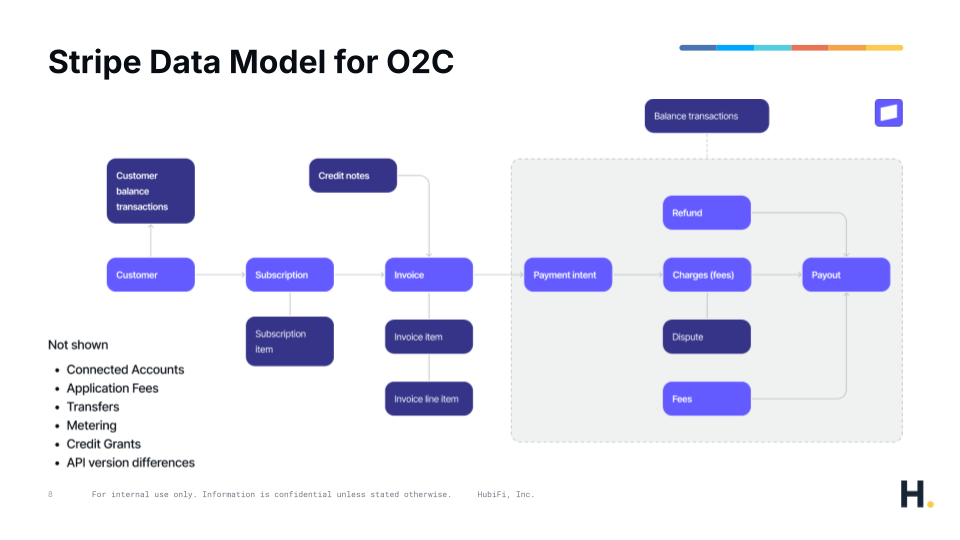
Stripe runs on roughly 30 different endpoints, and the objects that matter most for accounting nest inside one another in a specific order:
Customer → Subscription → Subscription Item → Invoice (header, invoice item, invoice line item) → Payment Intent → Charge → Payout
The detail that trips up most teams: Stripe conflates the concept of a contract with the invoice. Performance obligations, the actual "what am I on the hook to deliver, and over what term", live on the invoice line item, not on any higher-level contract object. There's no native Stripe report for "my contracts” so if you want that view, you have to build it.
A few other wrinkles worth knowing:
.png)
For manual Stripe accounting, three reports carry the entire order-to-cash cycle:
If you're on manual (not automatic) Stripe payouts, be aware: Stripe won't tell you which underlying transactions were paid out together.
Cody's recommendation is to switch to automatic payouts wherever possible as manual payouts force you into treating Stripe like an ever-building wallet balance, which is workable but painful to maintain.
.png)
Drawing on work with some of Stripe's highest-volume customers, Cody walked through the mistakes that show up again and again:
A few policy decisions come up repeatedly for Stripe-heavy businesses:
Excel can carry a Stripe close further than most people expect, but eventually the volume wins. Beyond the compliance risk of the errors above, Cody pointed to a subtler cost: manual Stripe accounting can devalue the accounting function itself.
When the close takes weeks to reconcile, FP&A stops waiting on accounting and starts pulling its own (usually incorrect) revenue numbers straight from invoices and the rest of the month gets spent reconciling two numbers that never should have diverged in the first place.
It also doesn't scale technically. Pushing raw Stripe transaction volume directly into an ERP like NetSuite can get prohibitively expensive and, at real scale, simply breaks. ERPs weren't built to carry that kind of transactional load.
This is the gap HubiFi's Stripe integration is built to close: full order-to-cash automation across all of Stripe's endpoints (invoicing, payments, connected accounts, application fees, metering, credit grants, and more), producing a daily, audit-ready close that both accounting and FP&A can work from, with journal entries pushed automatically to your GL or ERP.
Stripe is exceptional at what it was built for: frictionless self-serve payments, but it was not built to be a revenue recognition system, and its own native RevRec module tends to run into the same volume and GAAP-compliance limits that manual processes do.
Getting Stripe accounting right starts with understanding that the invoice line item, where your performance obligations live, and that cash hitting your bank account is the last step in the process, not the first one you should be accounting for.
Have questions about your own Stripe setup? Cody's happy to talk through your environment. Connect with him on LinkedIn.

Accounting Automation | Product | Technical Accounting | Accounting Systems Nerd
Cody Leach, CPA is a technology and automation focused CPA helping finance leaders bring their processes into the 21st century. He's advised finance teams around technical accounting and automation - such as Cursor, Meta, Strava, and many others and has helped SaaS and AI finance teams turn messy and usage data into clean, automated revenue reporting that actually matches how the business runs. Former KPMG auditor, Cody holds in Masters in Accounting from North Carolina State University. He is a CPA.
Enter your email to get our latest insights straight to your inbox.
*Or watch 2 minute demo here.
Power your high-volume business's revenue compliance and reporting needs with one platform.