
Sign in
Request a demo
Talk with an accountant.
Connect with us:
Thank you! Your submission has been received!
Oops! Something went wrong while submitting the form.

While most accounting education focuses on large B2B contracts, high-volume subscription businesses face entirely different obstacles for revenue recognition. This guide unpacks them and how to work around them.
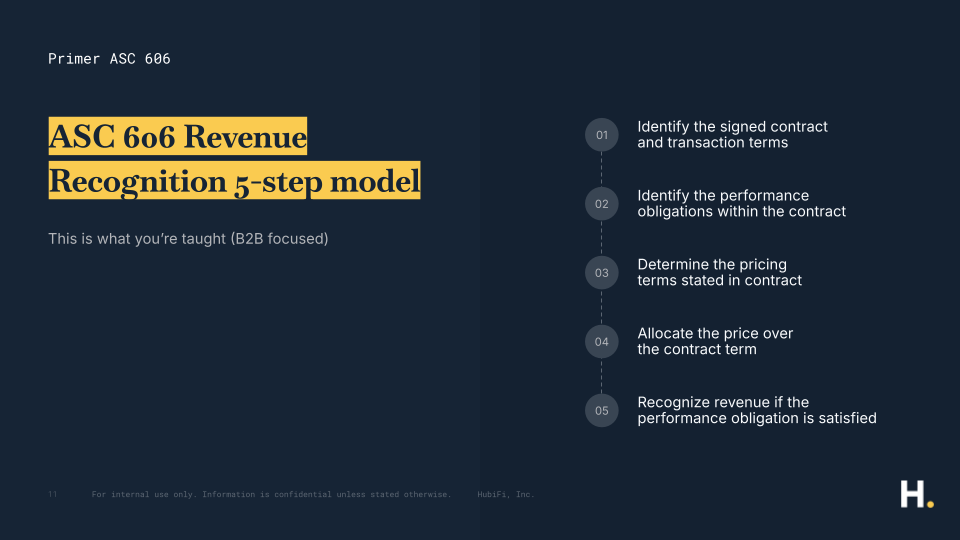
Accounting students learn ASC 606 through the five-step framework: identify the contract, determine performance obligations, establish pricing terms, allocate the price, and recognize revenue when obligations are satisfied. This works perfectly for enterprise deals where revenue accountants analyze individual contracts worth millions of dollars.
But this approach breaks down for companies processing thousands of subscriptions monthly through platforms like Stripe, Apple App Store, or Google Play. The problem isn't understanding the principles, rather it's applying them to 40,000 transactions with constant upgrades, downgrades, and cancellations.
Here’s a useful framework for thinking about revenue cycles: B2B companies typically handle high complexity but low volume, perhaps 30 enterprise contracts requiring detailed analysis. Consumer-facing businesses operate in the opposite realm: standardized contracts processed at massive scale.
The real pain point? Companies occupying both spaces simultaneously. A SaaS company might have enterprise contracts managed through Salesforce while running a self-serve product through Stripe. These businesses need two completely different accounting processes, and the systems that work for one rarely support the other.
Finance teams today sit between increasingly fragmented systems. While 1990s-era ERPs promised to centralize all business processes, modern companies choose best-in-class tools for each function. Sales teams use Salesforce. Billing runs through Stripe or Recurly. Payments flow through multiple processors. The accounting team inherits the job of connecting these disconnected pieces.
The result is that for most high-volume businesses, Excel becomes the only system fast enough to handle the data volume. Teams export reports from five or six platforms, manually compile revenue calculations, and post summary entries to the general ledger. The process takes days, loses transaction-level detail, and introduces material risk.
Several technical considerations become critical at scale:
Gross versus net revenue: When companies use connected accounts or operate marketplaces, determining whether to record gross revenue with separate cost of goods sold, or net revenue as an agent, requires careful contract analysis.
Standalone selling price allocation: In B2B environments, one revenue accountant might manually calculate SSP for a handful of complex deals. With thousands of subscribers upgrading and downgrading monthly, maintaining accurate deferred revenue balances and discount provisions becomes computationally intensive.
Cancellations and disputes: Consumer subscriptions generate higher cancellation rates and payment disputes. Each requires judgment: Is a failed first payment a revenue reversal (no contract existed) or bad debt (established payment history)? The accounting treatment differs, but tracking these nuances across thousands of transactions proves difficult.
Fee capitalization: The session highlighted an often-missed opportunity. While most companies expense Apple and Google's 15-30% fees immediately, these may qualify as commissions under ASC 340-40, allowing amortization over the subscription term. For growing SaaS companies, this can materially improve margins—but only if systems can track the amortization schedules.
High-volume revenue doesn't just create operational challenges. It multiplies audit risk. Every upstream system—Stripe, Apple, Google, internal databases—becomes an in-scope system requiring internal controls. When these systems feed Excel files for revenue calculation, auditors face limited ability to test transaction completeness and accuracy.
Revenue leakage becomes nearly inevitable. Companies discover they've been issuing unintended customer credits, paying excess taxes due to reconciliation failures, or receiving less than owed from app stores—sometimes totaling millions of dollars.
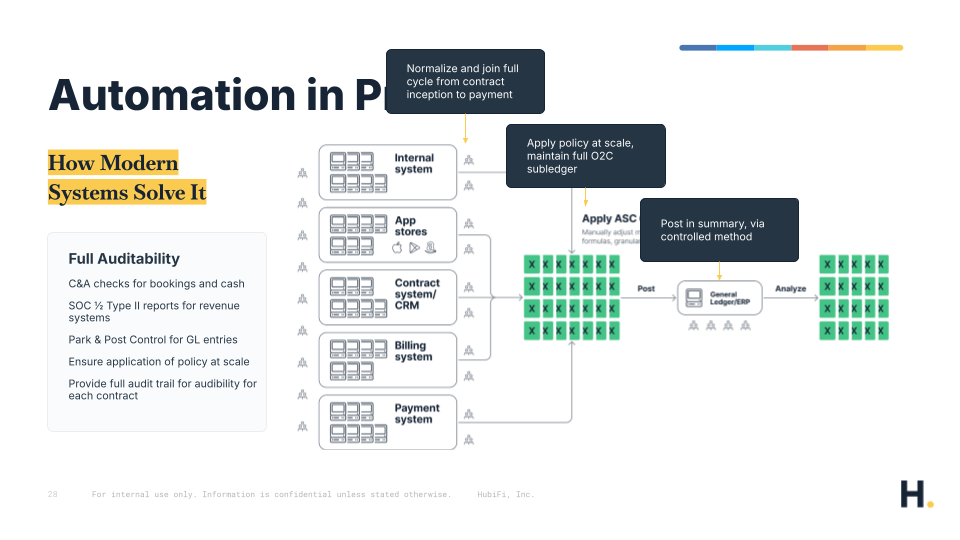
Companies processing significant subscription volume need purpose-built automation. The choice isn't whether to automate, but when and how.
Three common mistakes emerged: abandoning Excel too early (before reaching scale that justifies the investment), relying on Excel too long (past the point of audit compliance), and attempting internal builds without accounting expertise.
The most effective approach is investing in systems that normalize data from multiple sources, apply accounting policies at the transaction level, maintain detailed audit trails, and post to the general ledger automatically, all while meeting SOC 1 and SOC 2 compliance standards.
For high-volume businesses, revenue recognition isn't primarily an accounting policy question. It's a systems architecture problem that requires treating contracts, invoices, and payments as distinct but connected data objects. Companies that solve this foundational challenge can close faster, reduce headcount requirements, and actually trust their revenue numbers.

Accounting Automation | Product | Technical Accounting | Accounting Systems Nerd
Cody Leach, CPA is a technology and automation focused CPA helping finance leaders bring their processes into the 21st century. He's advised finance teams around technical accounting and automation - such as Cursor, Meta, Strava, and many others and has helped SaaS and AI finance teams turn messy and usage data into clean, automated revenue reporting that actually matches how the business runs. Former KPMG auditor, Cody holds in Masters in Accounting from North Carolina State University. He is a CPA.