
Sign in
Request a demo
Talk with an accountant.
Connect with us:
Thank you! Your submission has been received!
Oops! Something went wrong while submitting the form.

Here’s a question many finance teams are wrestling with: when does your tech stack actually need an upgrade, and when are you just chasing shiny objects? Hear from Lonnie Bloom, CPA (Withum), Walter Merkas (Withum), and Jason Berwanger (HubiFi) on when teams should customize their ERP and when it’s time to upgrade it entire.
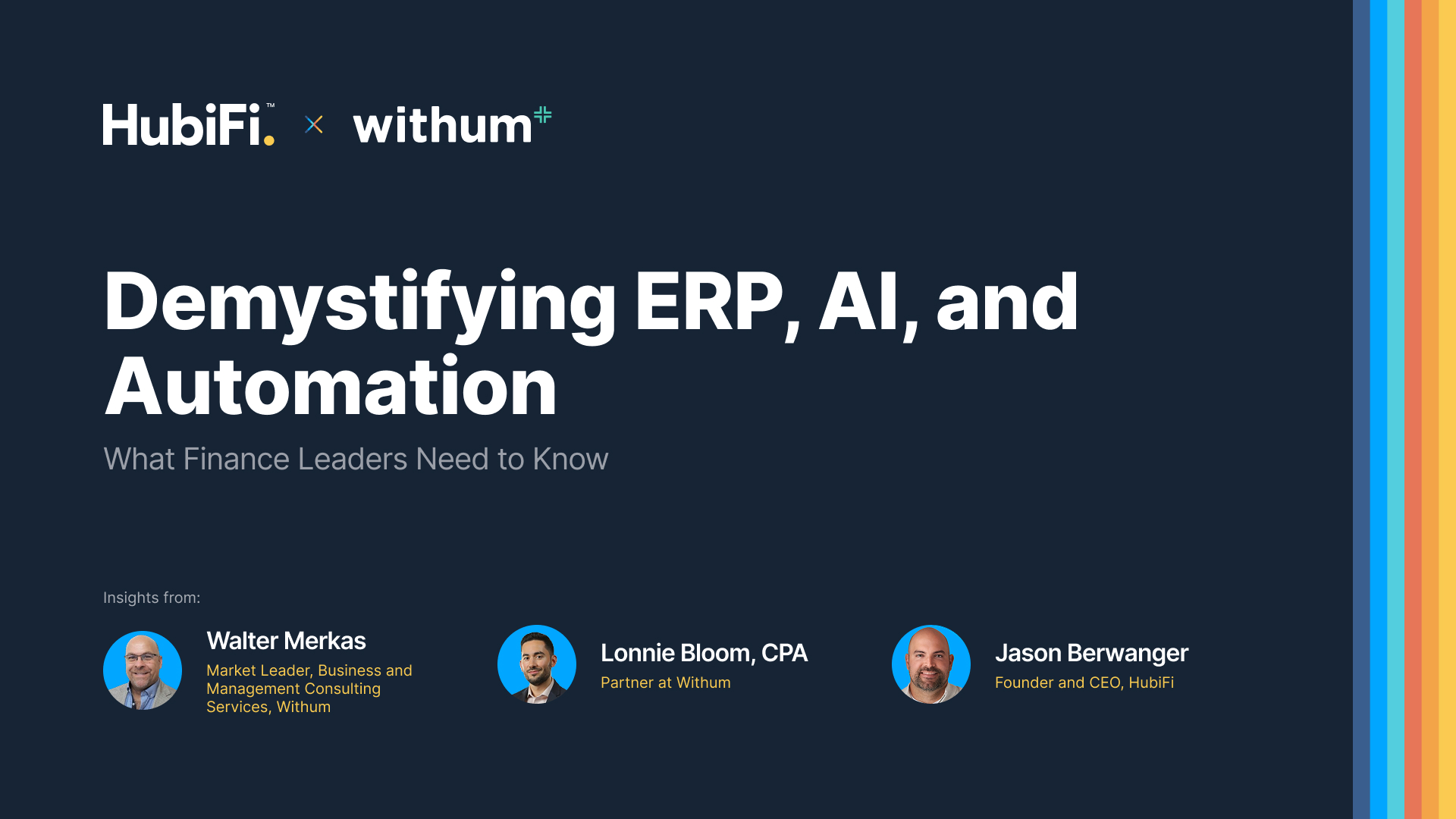
Here’s a question many finance teams are wrestling with: when does your tech stack actually need an upgrade, and when are you just chasing shiny objects? Hear from Lonnie Bloom, CPA (Withum), Walter Merkas (Withum), and Jason Berwanger (HubiFi) on when teams should customize their ERP and when it’s time to upgrade it entire.
It’s a constant refrain: "Our month-end close is taking forever. Should we buy a new ERP?" But that's asking the wrong question. A slow close is a symptom, not a diagnosis. The actual disease varies wildly depending on your business model.
For B2B companies with complex contracts but fewer customers, an ERP can genuinely solve problems. You're managing orders, entitlements, billing, and cash application in one place—that makes sense.
For B2C or high-volume businesses, the story changes completely. Your ERP becomes just another hub where accounting manually consolidates data from CRMs, billing systems, payment processors like Stripe, and order management platforms. Adding NetSuite in this scenario doesn't fix the problem—it just gives you a fancier general ledger while your team still drowns in reconciliations.
As Jason put it: "We got a better general ledger, but we didn't actually solve the problem."
A poll of 50+ finance and accounting leaders showed that what slows them down most is clustered around a few areas:
The pattern? Data fragmentation. One horror story involved a company with QuickBooks in the US, Xero in Mexico, and a different system in India—all reconciled manually in Excel by one controller. When that person left, institutional knowledge walked out the door.
When does it make sense to customize? Wally's advice is blunt: "Most implementers need to develop a backbone and say no."
The math rarely works in favor of customizing your ERP:
A better approach? Look for third-party solutions that actually solve the end-to-end problem. Not just another SaaS tool that becomes "another source of truth that isn't a source of truth”, but technology that takes a meaningful chunk of your workflow and genuinely automates it.
Everyone's pitching "AI-native" solutions right now. But here's what accountants need to understand: AI is probabilistic. You might get different answers to the same question. That's fine for some use cases—terrible for financial reporting where you're personally liable for the output.
The hierarchy that actually works:
Trying to slap AI onto messy data is like using a sophisticated search algorithm to find a truck when the inventory system doesn't track bed length. The problem isn't the AI—it's the inputs.
Before evaluating any new software:
A fast close isn't necessarily better than a thorough one. As Wally noted: "The goal is a close you can explain, defend, and trust."
Don't let FOMO around AI or ERP upgrades drive decisions. Instead, identify the actual constraint in your process. Sometimes that's technology. Sometimes it's people. Sometimes it's process documentation that walked out the door with your last controller.
Constraint breeds innovation—but only if you're solving the right problem.
Watch the full webinar recording here or contact us to discuss how HubiFi handles high-volume revenue recognition for SaaS and subscription businesses.

Former Root, EVP of Finance/Data at multiple FinTech startups
Jason Kyle Berwanger is an accomplished two-time entrepreneur, polyglot in finance, data & tech with 15 years of expertise. Builder, practitioner, leader—pioneering multiple ERP implementations and data solutions. Catalyst behind a 6% gross margin improvement with a sub-90-day IPO at Root insurance, powered by his vision & platform. Having held virtually every role from accountant to finance systems to finance exec, he brings a rare and noteworthy perspective in rethinking the finance tooling landscape.
Enter your email to get our latest insights straight to your inbox.
- OR -