Oops! Something went wrong while submitting the form.
January 21, 2026
HubiFi Research
Accounting
Automation vs. AI in Accounting - A Practical Guide to What Actually Works
The Uncomfortable Truth: 95% of AI pilots fail to deliver their promised outcomes. Meanwhile, accounting teams are drowning in manual work that deterministic automation could eliminate today. This guide will show you which problems need automation, which need AI, and critically, which one comes first.
95%
AI pilots fail to meet objectives
25%
YoY increase in audit deficiencies (PCAOB)
300K
Accountants left the profession (2020–2022)
The Real Problem: Decentralization Broke Accounting
Twenty years ago, ERPs were true enterprise systems. Orders, billing, fulfillment, cash—everything lived in one unified data model. The accounting was essentially done automatically.
Then customer innovation won out over internal controls.
Companies adopted Stripe for payments, Zuora for billing, Salesforce for contracts. The ERP became just the final destination—not the hub. Accounting teams found themselves stuck between a ledger that needed compiled information and third-party data sources speaking different languages.
We had NetSuite at Root Insurance, and the CFO said ‘we’re good, we have an ERP.’
But when we prepped for our IPO, the accounting team and I realized we were stuck between internally developed systems, subscription management,Braintree, Stripe, PayPal — and we had to build a ton of tech just to get auditable data into NetSuite.
— Jason Berwanger, CEO, HubFi
This decentralization created three critical problems:
Volume explosion: Transaction counts jumped from thousands to millions
Data fragmentation: Financial context spread across 10+ disconnected systems
Manual compilation: Accountants became data bridges, manually reconciling disparate sources
The result? A 25% year-over-year increase in audit deficiencies, with revenue accounting as the #1 failure area.
Understanding Deterministic vs. Probabilistic Outcomes
Before choosing between automation and AI, you need to understand a fundamental distinction:
Characteristic
Deterministic
Probabilistic
Output Type
Exact, provable answer
Range of likelihoods
Audit Trail
✓ Complete lineage
✕ Limited / no lineage
Consistency
✓ Same input = same output
✕ May vary between runs
Data Requirements
Structured, related data
Large training datasets
Best For
Compliance, reconciliation, revenue recognition
Forecasting, pattern detection, insights
Accounting Fit
✓ Core processes
✓ Strategic analysis
For accounting, this distinction is critical. When an auditor asks "how did you calculate revenue recognition for this customer?", "the AI said so" isn't an acceptable answer. You need deterministic automation with complete audit trails.
The Data Foundation Problem: Garbage In, Garbage Out (Amplified)
Here's the uncomfortable truth about AI in accounting: it amplifies your existing data problems rather than solving them.
The Broken Pyramid
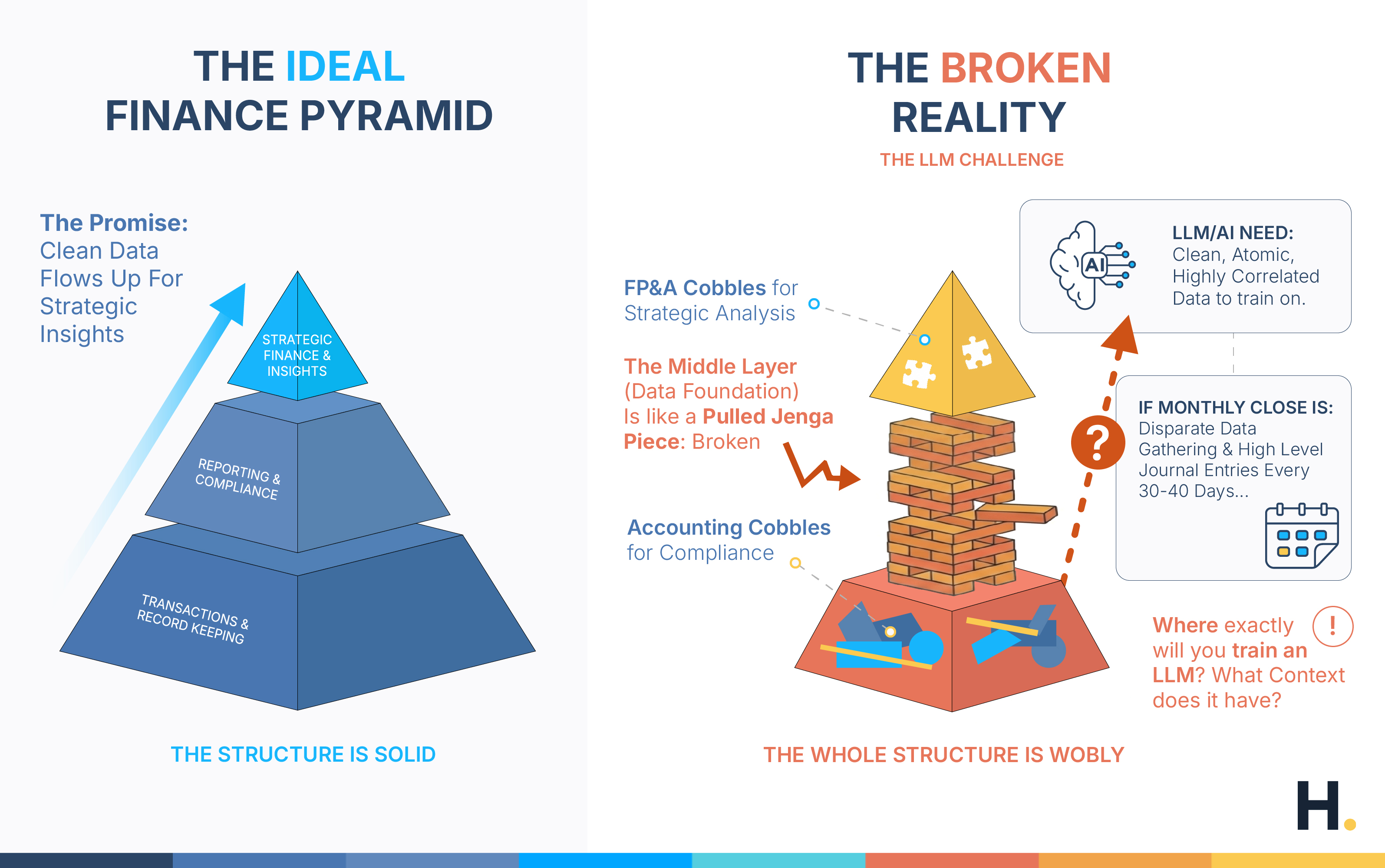
Investment analysts describe finance systems as a pyramid:
The promise: clean data flows from bottom to top, enabling strategic insights.
The reality: That pyramid is broken for most companies. FP&A cobbles together whatever they need for strategic analysis. Accounting cobbles together what they need for compliance. The middle layer—the data foundation—is like a Jenga piece pulled out. The whole structure is wobbly.
LLMs need clean, atomic, highly correlated data to train on. But if your monthly close consists of accountants gathering disparate data and translating it into high-level journal entries every 30-40 days, where exactly will you train an LLM? What context does it have?
If your FP&A analyst or accounting team can't get the answer with the data they have, it's highly unlikely that an AI or LLM could do it. The prerequisites simply aren't met.
— Jason Berwanger, CEO, HubFi
What AI Actually Can't Fix in Accounting
Let's be specific about where AI falls short for core accounting work:
1. It Can't Provide Auditability
When an auditor asks "how did you calculate this?", you need to trace every step back to source transactions. AI's probabilistic nature makes this impossible. Even if it gets the right answer, you can't prove why it's right.
2. It Can't Guarantee Consistency
Run the same AI query twice, you might get different results. This "stochastic" behavior—where randomness is built into responses—is fundamentally incompatible with the immutability requirements of accounting periods.
3. It Can't Replace Domain Expertise
The governance of accounting data requires human expertise: understanding organizational context, applying accounting policies, knowing what metrics mean for your business model. AI can assist, but it can't replace that governance.
4. It Creates a Dangerous Efficiency Illusion
If humans need to review and validate every AI output anyway, have you really saved time? Or have you just shifted from one tedious task (data entry) to another (validating AI outputs)?
There's a risk that AI erodes critical thinking. You're using a tool that gives you answers quickly with instant gratification and doesn't require critical thinking. That's dangerous, which is why accountants become more important in the governance aspect—even more so than historically.
— Jason Berwanger, CEO, HubFi
Where Automation Wins: The Deterministic Layer
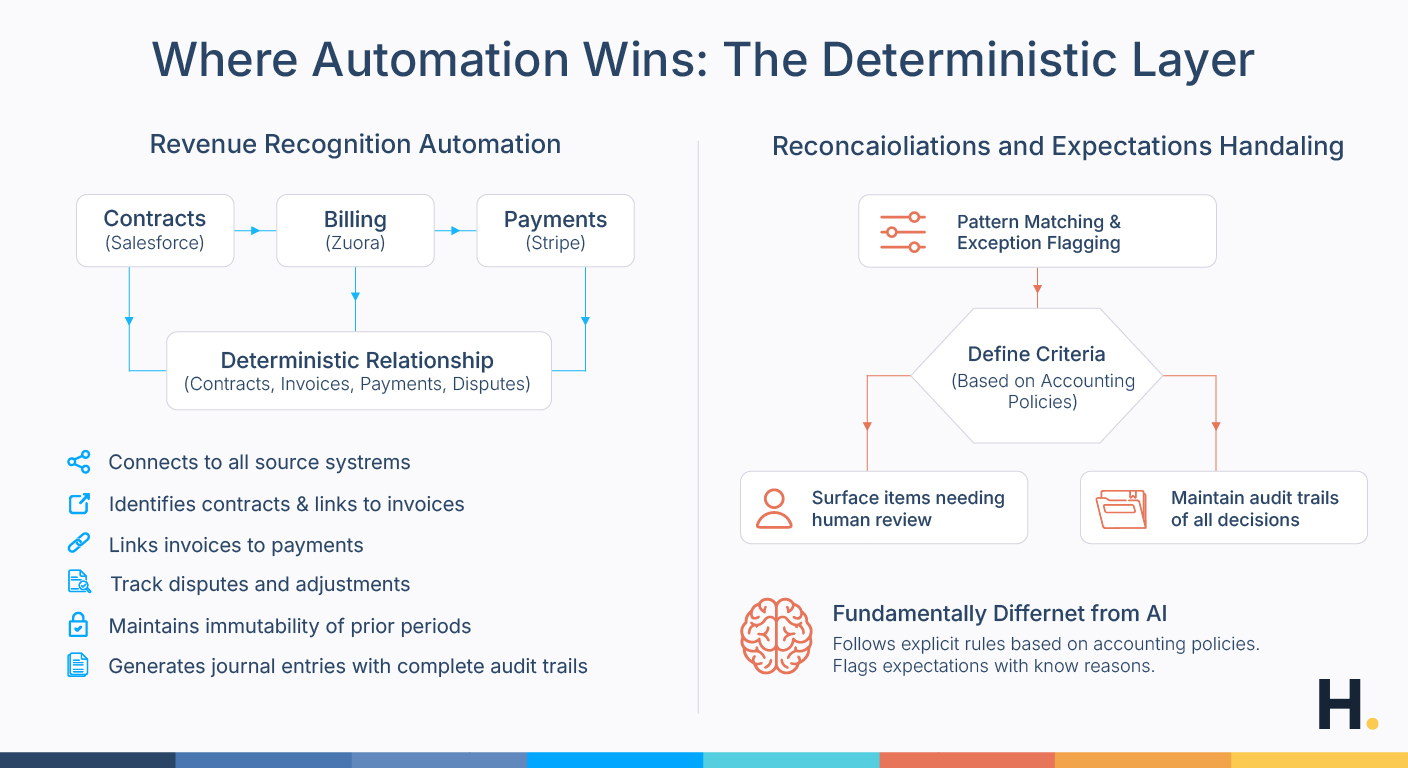
For most accounting teams, deterministic automation solves the immediate, critical problems:
Close Process Acceleration
With properly automated data pipelines, companies move from 30-day closes to daily closes. Not because AI is magically booking entries, but because deterministic relationships between transactions and outcomes are captured continuously rather than compiled monthly.
Once you automate your close and get to a daily close output, you're elevating people from compiling data to being strategic business partners who can translate operational performance into financial insights.
— Jason Berwanger, CEO, HubFi
Where AI Actually Adds Value: The Strategic Layer
Once you've built the deterministic foundation, AI becomes incredibly valuable for the strategic layer:
Contract Analysis and Data Extraction
AI scanning contracts to extract performance obligations, terms, and clauses is legitimate. The key: this extraction feeds into deterministic automation that calculates the actual accounting treatment.
You can use AI to scan contracts and standardize outputs from variable language.But there's still a 15% jump from scanning to getting data into a format that deterministic systems need. You need both layers working together.
— Jason Berwanger, CEO, HubFi
Anomaly Detection
Once you have clean, atomic, time-series financial data, AI excels at finding patterns and outliers:
Which customer segments have highest default risk?
Where are we seeing unexpected revenue leakage?
What product combinations generate best margins?
These probabilistic answers don't need audit-level precision—they're directional insights that help you ask better questions.
?
Which customer segments have the highest default risk?
?
Where are we seeing unexpected revenue leakage?
?
What product combinations generate the best margins?
FP&A and Forecasting
Scenario planning, sensitivity analysis, predictive forecasting—natural fits for AI because you're explicitly dealing with probabilities and ranges.
Critical Insight: All of these valuable AI applications require the deterministic automation layer underneath. Without it, the AI has nothing reliable to train on.
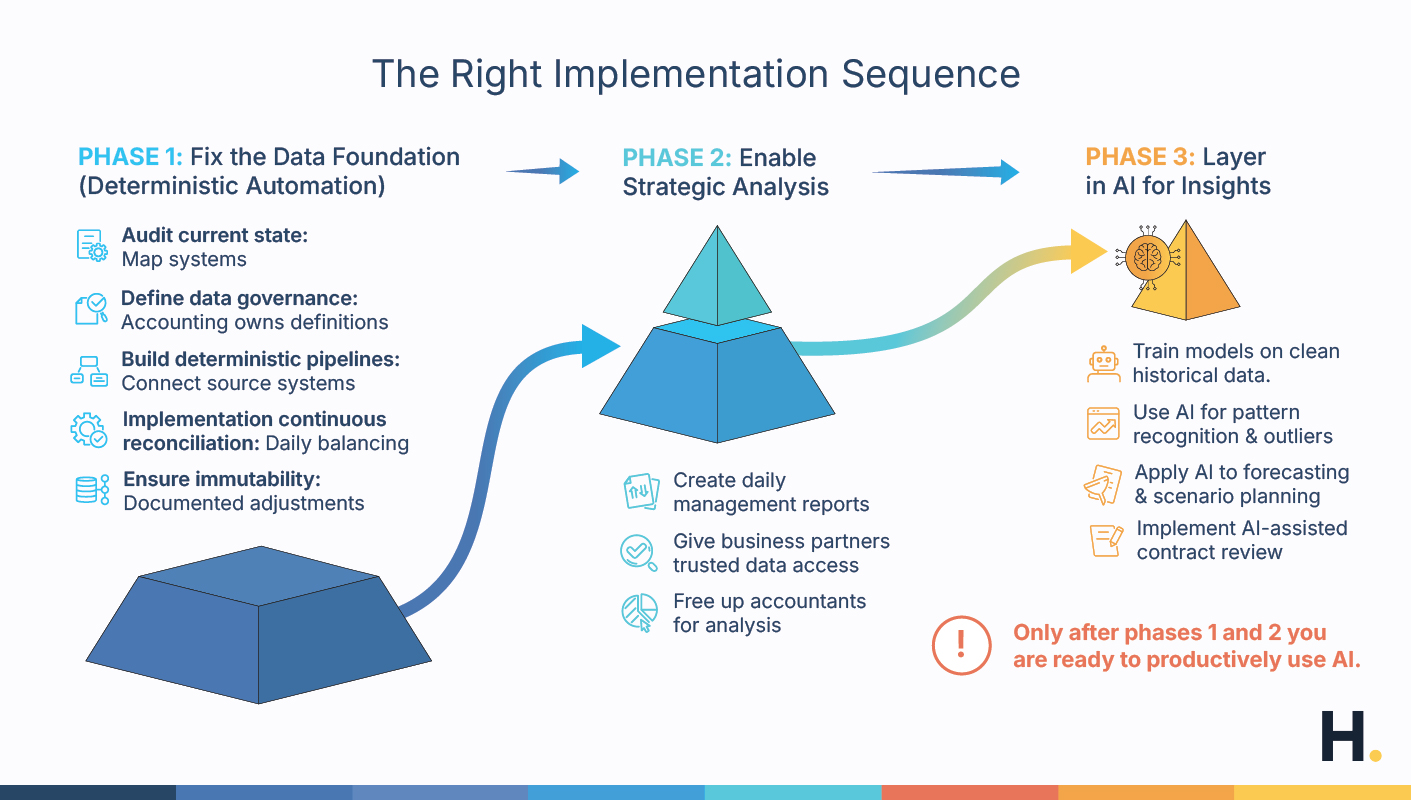
The Right Implementation Sequence
Based on real-world implementations with high-volume consumer transaction companies, here's what actually works:
Phase 1: Fix the Data Foundation (Deterministic Automation)
Audit your current state: Map all systems where financial data originates
Define your data governance: Let accounting own the definitions of key metrics
Build deterministic pipelines: Connect source systems with proper relationship modeling
Implement continuous reconciliation: Don't wait 30 days to know if things balance
Ensure immutability: Build protections so prior periods can't change without documented adjustments
Phase 2: Enable Strategic Analysis
With clean data flowing, you can now:
Create management reports that refresh daily instead of monthly
Give business partners access to financial data they can trust
Free up accountants from compilation to analysis
Every time I've seen this happen, it benefits the P&L owners dramatically. Now they're using the right data to make decisions versus trying to make right decisions without right data.
— Jason Berwanger, CEO, HubFi
Phase 3: Layer in AI for Insights
Only after phases 1 and 2 are you ready to productively use AI:
Train models on your clean historical data
Use AI for pattern recognition and outlier detection
Apply AI to forecasting and scenario planning
Implement AI-assisted contract review feeding deterministic systems
Why Sequence Matters: Companies that jump straight to AI without fixing the foundation inevitably hit a wall. The 95% pilot failure rate isn't because AI doesn't work—it's because companies try to use probabilistic solutions for deterministic problems.
Self-Assessment: Are You Ready for AI?
Answer these questions to determine whether your organization needs
automation, AI, or foundational work first.
Evaluating Vendors: What to Look For
The explosion of “AI-powered accounting” solutions makes vendor selection treacherous.
Here’s how to cut through the noise:
✕ Red Flags
✓ Green Flags
Founders with no accounting background
If they’ve never lived your problem, they probably don’t understand the full scope.
Practitioner founders
People who’ve actually done the work understand real-world complexity.
Heavy venture funding with few customers
20 customers and $20M raised? That’s 12 months of runway.
Cashflow positive or close
Sustainable unit economics matter more than flashy growth.
Can’t explain audit trails
If they can’t show exactly how they arrived at a calculation, run away.
Clear automation story
They explain the deterministic layer before mentioning AI.
All AI, no automation foundation
If everything is LLM-based with no deterministic layer, it’s not production-ready.
Customer retention
Talk to customers who’ve been using it for 2+ years.
Growth-at-all-costs mentality
For compliance-critical tools, you need partners who’ll be around in 5 years.
Industry presence
If they’re at industry conferences three years running, they’re serious.
I would have no idea how to make a long-term decision right now if I'm being honest. If you look at marketing and case studies on the surface, you have no idea how to differentiate somebody that's demo-land behind the curtain from somebody who can actually help you.
— Jason Berwanger, CEO, HubFi
The Human Element: Elevation, Not Replacement
One persistent fear: will automation and AI eliminate accounting jobs? The real-world evidence says no—but roles absolutely evolve.
Our last five implementations—in every single case, when someone moved from compiling transactions to having automation handle it, they discovered six and seven-figure opportunities their business was missing. Revenue leakage, profitability issues, sales tax that should be called back, bad debt write-offs nobody looked into.
— Jason Berwanger, CEO, HubFi
The accounting profession's current crisis isn't about too many accountants. It's about too many accountants stuck in soul-crushing compilation work when they could be doing strategic analysis.
The Shift in Role
Controllers who spent 70% of their time on monthly close compilation now spend that time on:
Margin analysis by product, customer, and channel
Pricing strategy informed by actual contribution data
Business partnership translating ops into financial outcomes
Proactive identification of revenue leakage and opportunities
That's not just better for the business—it's why people chose accounting in the first place.
Accounting and finance have unique oversight of the business. When you automate the transaction layer, those people become your best strategic partners for translating operational decisions into financial outcomes.
— Isaac Heller, CEO, Truli
Your Action Plan
If you're leading accounting or finance at a high-growth company, here's your roadmap:
Immediate Steps (This Week)
Audit your data chaos
Map every system where financial transactions originate. Be brutally honest about what's manual, what breaks, what changes unexpectedly.
Calculate cost of status quo
What's your actual monthly close time? Hours in reconciliations? Opportunity cost of your best people doing compilation?
Define your north star metrics
Let accounting own the governance of revenue, contribution margin, and other key measures. Document what these mean in your specific context.
Short-Term (0-6 Months)
Prioritize revenue automation
If you haven't solved revenue-to-cash with high-volume transactions across multiple systems, that's priority #1. Biggest compliance risk and highest business value.
Build or buy the deterministic layer
Focus on automation providing complete audit trails, maintaining period immutability, and handling your specific billing platforms.
Resist AI pilot pressure
Unless you have clean, atomic financial data flowing continuously, AI pilots will fail. Get the foundation right first.
Long-Term (6-18 Months)
Measure what matters
Track close time and reconciliation hours, but also business impact. Are your financial insights changing operational decisions?
Layer in strategic AI
Once your deterministic foundation is solid, experiment with AI for pattern recognition, forecasting, and analysis in low-risk applications.
Invest in your team
The automation dividend isn't headcount reduction—it's elevation. Help your team develop strategic skills to use their freed-up time.
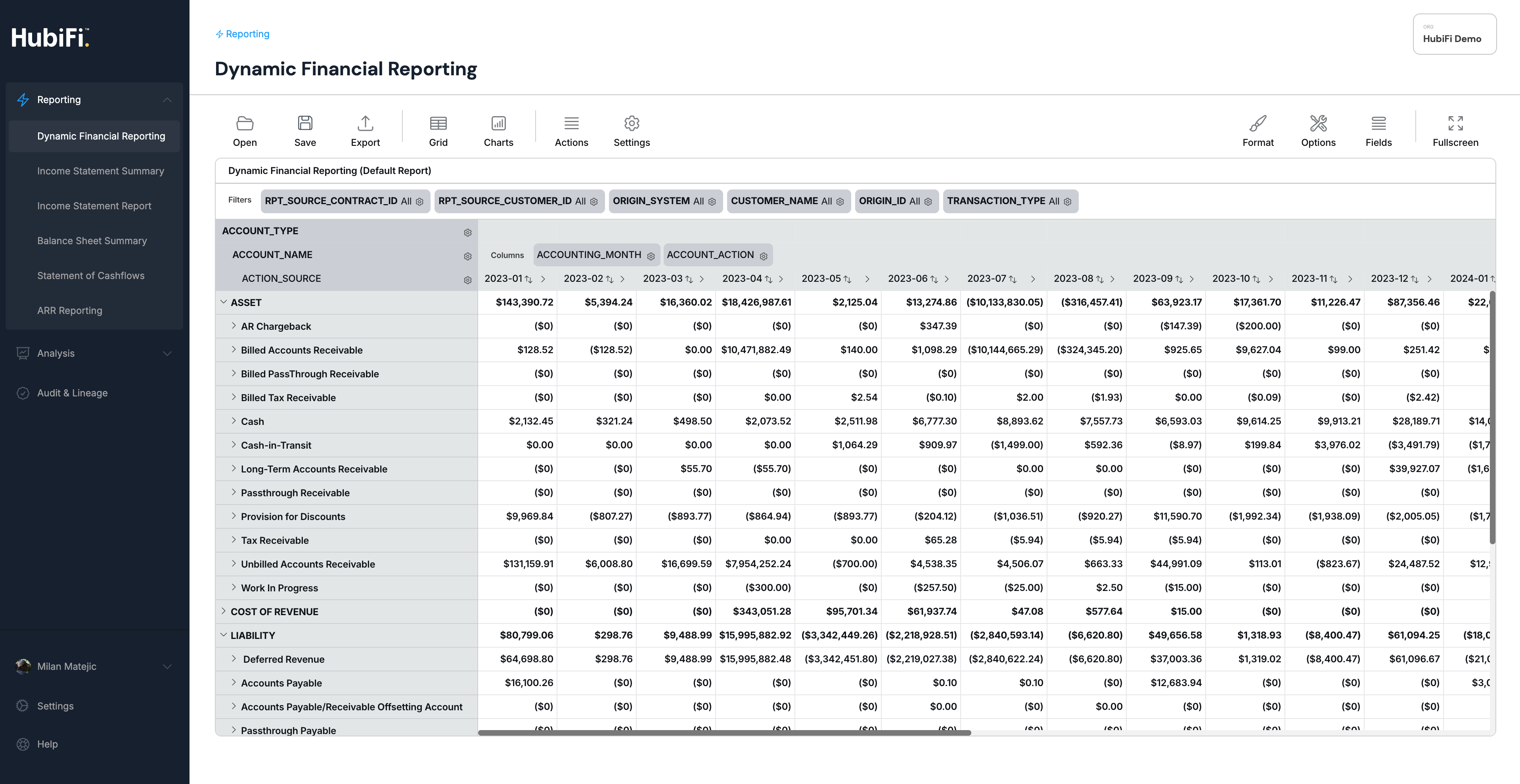
What real-time automation look like.
The Bottom Line
Automation and AI are both transforming accounting—but in fundamentally different ways, solving different problems, and requiring different sequences.
Automation handles the deterministic problems accounting is built on: precise calculations, audit trails, period immutability, reconciliations.
AI handles the probabilistic problems that extract insight from that foundation: pattern recognition, forecasting, anomaly detection, scenario planning.
Trying to use AI without automation is like building the top floor without the bottom floors. It looks impressive in demos, but it doesn’t work in production.
*This guide draws from conversations with Jason Berwanger (CEO, HubiFi), Isaac Heller (CEO, Truli), and Em Daigle (Founder, Automates community), along with insights from real-world implementations across high-growth SaaS and consumer subscription businesses.
HubiFi Research
Insights on modern finance, accounting, and automation.
A publication focused on the intersection of finance, technology, and business reality. We explore how modern companies build financial infrastructure, navigate compliance, and turn fragmented data into clarity through automation and smarter systems.
Table of Contents
Subscribe to a newsletter
Enter your email to get our latest insights straight to your inbox.
Thank you! Your submission has been received!
Oops! Something went wrong while submitting the form.