
Sign in
Request a demo
Talk with an accountant.
Connect with us:
Thank you! Your submission has been received!
Oops! Something went wrong while submitting the form.

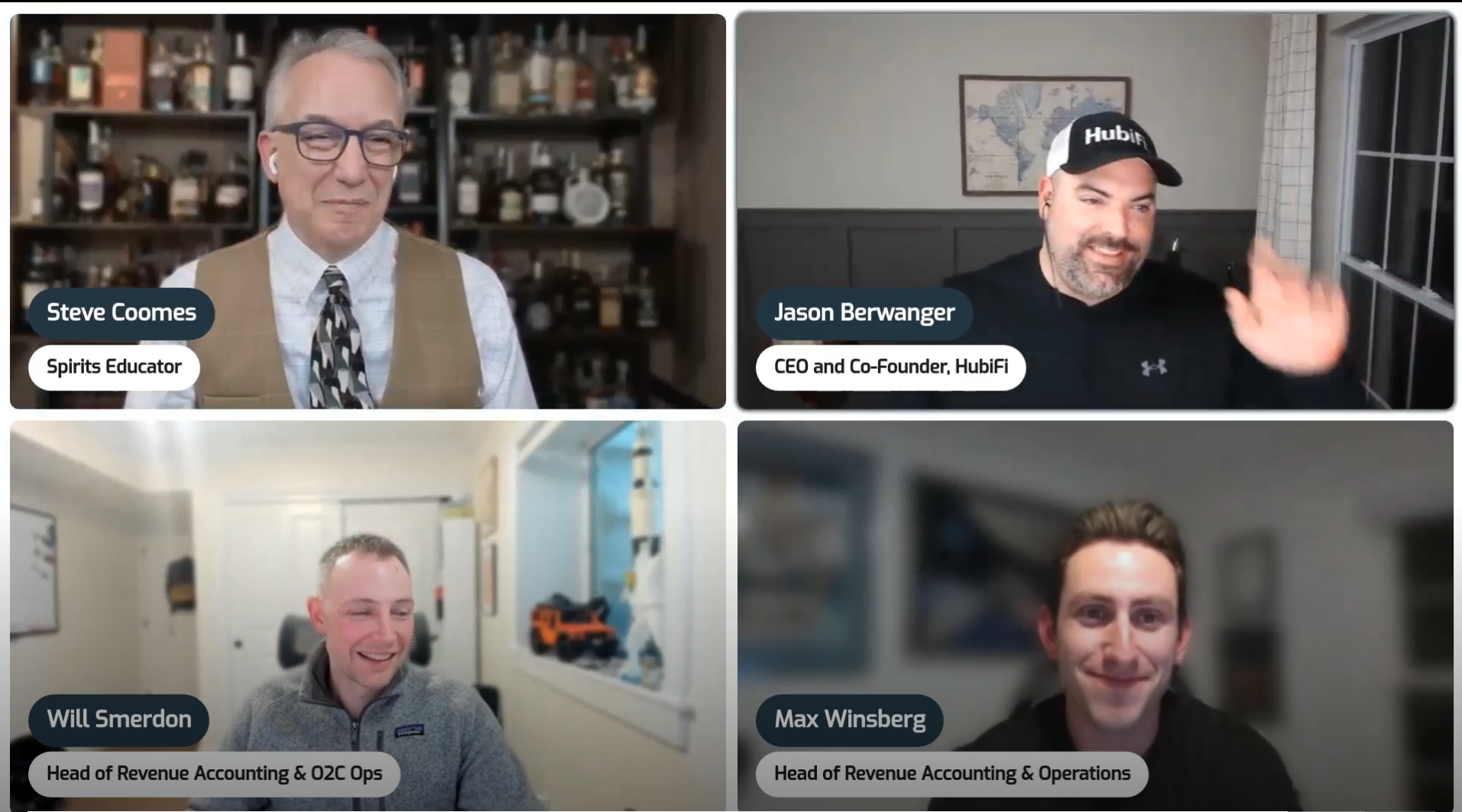
At our recent Bourbon event, we sat down with Will from Cursor and Max from Miro to hear how their teams handle accounting at serious scale. Both lead revenue accounting and order-to-cash operations at companies processing hundreds of thousands (and in Cursor's case, millions) of transactions. Between tastings of Wyoming Whiskey and Woodford Double Oaked, they shared some hard-won lessons about what it actually takes to build a finance function that keeps up with hypergrowth.
Revenue accountants at high-growth companies know the feeling. You are spending more time reconciling data across systems than actually analyzing it. And the bigger the company gets, the worse it becomes.
At our recent Bourbon event, we sat down with Will from Cursor and Max from Miro to hear how their teams handle accounting at serious scale. Both lead revenue accounting and order-to-cash operations at companies processing hundreds of thousands (and in Cursor's case, millions) of transactions. Between tastings of Wyoming Whiskey and Woodford Double Oaked, they shared some hard-won lessons about what it actually takes to build a finance function that keeps up with hypergrowth.
Cursor's self-service business drove the company to roughly $700 to $800 million in ARR almost entirely through Stripe. That is a testament to what a product-led growth model can accomplish. But Will was candid about what happens at the other end of that volume: basic Stripe reports simply stop working. They fail to load. They time out. The platform that made it easy to collect payments becomes a bottleneck when you need to report on them.
That is the inflection point where you need a transformation layer between Stripe and your ERP. Without it, your team is stuck downloading reports, pasting data into spreadsheets, and manually reconciling activity across systems.
Max described a similar pattern at Miro. His team pushes every Stripe transaction into NetSuite using SuiteSync and manages hundreds of thousands of transactions each month. The problem? Edge cases. Customer balance transactions, downgrades, credits. Each one requires a workaround, usually a custom NetSuite script. Fix one issue and another one surfaces. It felt, as Max put it, like a full-time job just maintaining the status quo without providing any real value to the business.
Both speakers landed on the same core insight, even though they came at it from different angles.
Will put it simply: you need to get the deterministic layer right before AI becomes useful. He referenced a conference he attended the week before where the advice was identical. Get your data clean and your automations running first. Otherwise, layering AI on top of messy inputs just produces messy outputs faster.
He shared a practical example. Using Cursor's own product, he built a live reconciliation dashboard in about an hour. It pulls Stripe data, HubiFi data, and NetSuite journal entries from Databricks and surfaces variances automatically. No more downloading reports. No more manual matching. The dashboard updates weekly and breaks down discrepancies into categories so the team knows exactly what to follow up on. That is the payoff of having clean, automated data pipelines: the AI tooling on top becomes genuinely useful instead of a science project.
But Will was also honest about the learning curve. When he first joined Cursor, he found himself building things for the sake of building them. The product makes it easy to spin up tools fast, and there is a real temptation to over-engineer. What changed was stepping back and asking product management questions: What has the highest ROI? Where do I have the deepest understanding of the process? Build there, and only there.
Max took the conversation in a slightly different direction. For his team, the biggest benefit of automation was not just saving hours. It was uncovering business problems that would have stayed hidden otherwise.
When Miro implemented HubiFi, the team had to take inventory of every existing process and ask why things were done a certain way. That exercise surfaced a real issue: Miro was allowing mid-contract downgrades that created orphaned data in Stripe, which never synced properly to NetSuite. The team was overstating revenue without manual intervention, and the reconciliation alone took weeks.
Once the automation handled the data flow, Max's team had the breathing room to bring a recommendation to leadership: stop allowing that type of downgrade entirely. The result was better for the business, not just for accounting. They also revamped how startup credits were issued, switching from customer balance entries to trackable coupons with expiration dates.
That is the shift both speakers described. When you are not buried in reconciliation, you can actually partner with the business. You can spot patterns, question decisions, and make recommendations backed by real data.
The advice from both Will and Max boils down to a few practical points. First, automation and data quality are the baseline, not the finish line. Second, do not build what has already been solved by existing tools. Third, when you do build, focus on areas where you are the subject matter expert. And finally, think of progress over perfection. The tools you build today do not need to be enterprise products. They just need to relieve pain now and point you toward what comes next.
Or as Max framed it: ask yourself what breaks if your transaction volume doubles tomorrow. Then fix that first.

Former Root, EVP of Finance/Data at multiple FinTech startups
Jason Kyle Berwanger is an accomplished two-time entrepreneur, polyglot in finance, data & tech with 15 years of expertise. Builder, practitioner, leader—pioneering multiple ERP implementations and data solutions. Catalyst behind a 6% gross margin improvement with a sub-90-day IPO at Root insurance, powered by his vision & platform. Having held virtually every role from accountant to finance systems to finance exec, he brings a rare and noteworthy perspective in rethinking the finance tooling landscape.
Enter your email to get our latest insights straight to your inbox.
*Or watch 2 minute demo here.
Power your high-volume business's revenue compliance and reporting needs with one platform.